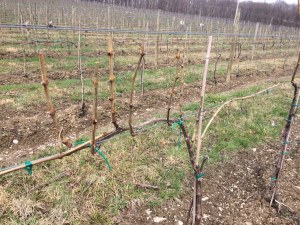
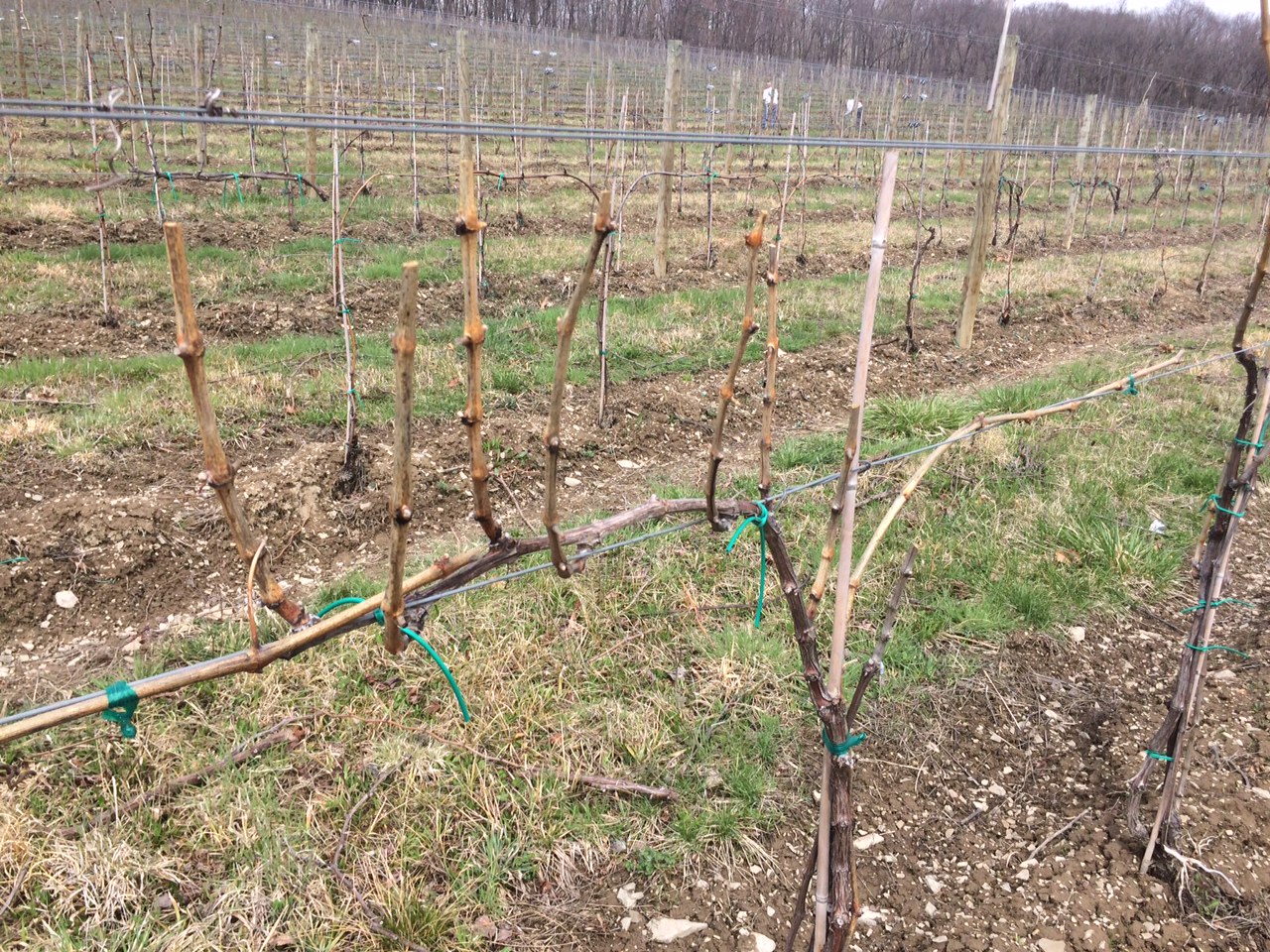
Spur and Kane pruning on same vine @ Briar Valley Vineyards
Welcome to the 2nd Annual ” State of the Vineyard” address. the purpose of this post is to give everyone a first look at the 2015 growing season as seen through the eyes of the people who know it best, the growers and wine makers of Western and Central Pennsylvania. After a winter that broke records for cold and snow I found unexpected good news on all fronts. But don’t take it from me read what the experts had to say.
We will start in Central Pennsylvania with Paul Vezzetti winemaker at The Vineyard at Hershey. Paul tells me that their vineyards made it through the winter relatively unscathed by the sub-zero temperatures, even the normally cold sensitive Chardonnay and Riesling showed little damage and with pruning complete he is looking forward to a really big year. A year that will see a new block of vines added to the vineyard that will consist mostly of Muscat but also some Sauvignon Blanc.
Staying in Central Pa. our next stop is Lewisburg and Chuck Zaleski’s Fero Vineyards & Winery. Chuck grows only vinifera vines and over the last two winters his vine injury has been limited to only a “couple percent”. He feels fortunate to have his vineyard in the Middle Susquehana Valley on a small hilltop in a wide river valley at 41ºN latitude and 600 feet above sea level. He attributes his site for his excellent survival rate that his vineyard has experienced over the years. I want to congratulate Chuck on winning a Double Gold medal at the Finger Lakes International Wine Competition (FLIWC) with his 2013 Estate Lemberger and a Gold with his 2013 Saperavi also at FLIWC.
We now move west into Washington County the home of Ripepi Vineyards & Winery. Rich Ripepi is pleased with how his vines came through this winter. He lost some of his Cabernet Sauvignon vines last winter but the ones that survived made it through this winter in fine shape. The bud count is very good and is a product of an extremely strong growing season in 2014. The only negative Rich could report was a little damage to his 28-year-old Chancellor vines but he couldn’t put his finger on the exact cause. With all the primary trimming complete and half of the secondary done Rich could only express the highest hopes for this coming growing season.
I can never go to Bedford County without stopping to see Tod & Jean Manspeaker at Briar Valley Vineyards & Winery. Tod tells me that this winter was better than the winter of 2014 for their vineyard. The 2014 winter had two freeze events with the second damaging some vines by splitting their trunks and causing “Crown Gall” which will eventually destroy a vine once it’s infected. But this year was different, most of Briar Valley’s vines came through in good shape with the only exception being their Merlot. They had thought they lost 100% of the Merlot vines and had order new vines only to discover that a third of the vines had survived. Tod commented on how differently each variety of his vinifera grapes vines adapted to the environmental factors even though they were all on the same site. The Manspeakers are very busy now with about 1 to 1 1/2 weeks more of pruning to do on their 10 acre vineyard. They do all the pruning themselves to insure that the fruit meets their very high standards. The job this year was made even more difficult by the fact that all the extra canes left on last year had to be removed to prepare the vines for this years growing season. I am happy to report that Briar Valley Vineyards & Winery won two Silver medals at the Finger Lakes International Wine competition (FLIWC) with their 2010 Proprietor’s Red and 2012 Lemberger.
Our next stop is Greene County to visit Rick Thistlewaite at Thistlewaite Vineyards in Jefferson. Rick told me his vines had a “little more die back” this year but overall damage was minor with it limited to one or two vines per acre. The bud count at Thistlewaite is reported to be good. A two tier pruning protocol is employed where the first pruning leaves a long cane to develop buds that is then cut back with a second pruning after the first frost to give protection against late frost bud damage. When I asked Rick if he thought the site was a contributing factor in this year’s losses, he said that he didn’t think it was because his five acre vineyard is on a hilltop and is planted with all French hybrid vines. His opinion was that this past winter was wetter than last year and he had less snow cover to protect his vines. Thistlewaite Vineyards are planted with nine different varieties of wine grapes with the majority of the vineyard composed of Chambourcin and Traminette. Rick is anticipating another above average harvest this year.
For our last stop in Pennsylvania we will travel to the heart of the Laurel Highlands and make a visit to Christian W. Klay Winery in Chalk Hill. I had the pleasure of meeting Sharon Klay recently and had the opportunity to hear for myself how the winter effected her vineyard. Sharon said this winter wasn’t nearly as destructive to her vines as the last winter was. I could hear the lingering lament in her voice as she recalled losing two acres of her oldest Chardonnay last year but she quickly brightened when she reported the lack of damage this year and the promise of another banner year that lay ahead. I laughed as she told me the resident flock of wild turkeys at the vineyard had discriminating palates for which grapes they ate while leaving others varieties relatively untouched. On the day we talked her son, Christian had just received government approval for his distillery. After becoming fully operational it will offer a synergy with the winery by not only producing its own distilled spirits but using C.W.Klay wine to make grappa, brandy and other distilled products.
No report would be complete without checking in with our friends in the Finger Lakes Wine Region. Martha “Marti” Macinski reports the vines at Standing Stone Vineyards & Winery Hector, NY do not seem to have suffered damage from this winter. She said the current bud count numbers are showing minimal damage, so minimal that “We did some samples twice”. Last year the samples also showed minimal damage and the crop was of normal quantity with overall quality outstanding. Riesling and Gewürztraminer continues to be strong varieties for Standing Stone with positive growth in the New York Metro area due to the efforts of distributor Fredrick Wildman. When visiting FLX a stop at Standing Stone Vineyards & Winery is a must for any wine lover.
Thank You to everyone that helped me with this post. I wish all the vineyards and wineries the best of luck in 2015 and I hope to see you soon. Rich





 wpawinepirate