Winemaker: Adam Sabelli-Frisch

                As with most things in life the saying “What was old is new again” rings particularly true when it comes to trends in the wine world. Anyone that has read this blog can attest to my curiosity with the ancient wine grape Saperavi and its resurgence worldwide but more specifically here in the U.S. The Mission grape has a storied past in California but fell out of favor with the winemaking community in the early part of the last century. Countless acres of vines have been pulled out and the land used for other projects. When I heard of a winemaker producing wine from Mission grapes and other lesser know varieties I was intrigued. I contacted Adam Sabelli-Frisch owner/winemaker of Sabelli-Frisch Wines in Santa Clarita, California and asked him for an interview to find out more about him, his winemaking philosophy and his plans for bringing back some very interesting wine grapes that haven’t been widely produced in decades.

I want to take this opportunity to thank Adam for the time and honesty he shared with me for this article. What follows is my unedited interview with Adam Sabelli-Frisch of Sabelli-Frisch Wines.


                       How did you get started making wine?

Like so many others, I started with home winemaking. Very bad at first, but it gradually improved. Like most home winemakers, I harbored a dream of eventually doing it professionally, which

Mission Grapes Photo Courtesy : Sabelli-Frisch Wines

certainly isn’t a new idea by any means. And one of my bad or good character traits, depending on how you look at it (or if you’re my wife), is that when I decide something, I launch into it pretty quick and without much fear. So by the summer of 2018 I’d decided I wanted to try this for real, and in Sept of that year I was already doing my first harvest!

How would you describe your winemaking style?

I would say that I lean towards making more old world type wines in the new world. Not austere in any way, just a little more restrained than perhaps is the CA style that has prevailed in the last decades. But still embracing the possibilities of the warmer climate wines we can make here. Perhaps a more accurate description would be that I try to make them in the earlier California tradition of the 60’s and 70’s before the big

Flame Tokay Grapes Photo Courtesy : Sabelli-Frisch Wines

styles became the norm.

Who and what had the greatest influence on your winemaking?

I wish I could mention a mentor, but since I didn’t come up through a traditional winemaking background, and have another job to support this still, I never had the chance to work under others (which I very much regret). I would say that maybe Emile Peynauds book Knowing And Making Wine was the closest to something like that.

How did you get interested in growing and making wine from grapes not being widely grown commercially?

That is a long story that I will try to shorten as much as I can: During my early winemaking I was predominantly drinking and making so called ‘natural wines’ (I prefer to refer to them as low-intervention wines these days, rather than natural).That

Petit Manseng Grapes Photo Courtesy: Sabelli-Frisch Wines

was the focus I wanted to bring to making my own wines – naturally fermented, not filtered and with low sulphur additions. In any case, I thought it would be interesting to also take that concept one step further. And in my mind it didn’t make sense to do low-intervention wines and then use imported and non-native grape varieties to do it from. So I wanted to make my wines using the American native strands, vitis labrusca and vitis rupestris etc. But after personal research and trials, I came to the conclusion that they are very challenging to make good wine out of. It was just a bridge too far for a new winemaker. So I regrouped and said: “well, which is the oldest vitis vinifera strand in the US?” And the answer is of course Mission. It’s the oldest European grape in the New World and has been in the Americas for more than 500 years now. So that seemed like a good fit. Only when I started making wine from it did I fully realize how amazing and rewarding that grape is.

What are your favorite varietals to work with and why?

I love Mission with a passion. It has been maligned, discredited, mistreated and ripped out for over a century now. You open older winemaking books and they all refer to the grape as inferior and not suitable for making wine at all. It is completely misunderstood. And when you take the time to understand it, you’ll find it makes world class wines. That might sound hyperbolic, but I actually believe that is the case. Mission has a great future ahead of it, and I’m convinced it will have a big resurrection.

What are some of your favorite wines and from which regions and producers?

I used to be heavily into Amarone in my youth and have a good

Syrah Grapes Photo Courtesy :Sabelli-Frisch Wines

collection of them still. But as you get older, seems like the palate changes and you go for more subtler styles. Last years it’s for me mainly been California or Oregon wines with a good mix between natural wines from small producers and a lot of Pinot Noir. My knowledge is limited to CA and OR wine and I don’t have a lot of knowledge about European producers, which is kind of ironic as I’m from there myself. I really enjoy Lioco, Failla, Ceritas,, Stirm, Broc Cellars, Deux Punx, Sandlands and producers like that here in CA. It’s a very exciting time for CA wines and there’s a change of guard as we move away from the Napa style.

What wines are you working on now and what are your expectations for them?

Well, my interest for rare, underused or strange grape varieties continues. Beside Mission, this year I did a Petit Manseng white for my limited edition Milk Fed line. It’s a yearly recurring edition where the grape changes, but the vinification in amphorae and with light skin-contact doesn’t change. Very small production and one-off’s for each vintage, so they’re always exciting. I also came back to my Alicante Bouschet which turned out so well in 2018 vintage. Really a wonderfully subtle wine. And my Flame Tokay rosé I continued this year as it also turned out so nice last time (Flame Tokay is another almost extinct grape). In the future I’m looking to explore more varieties – I almost got some Negrette and Cabernet Pfeffer this year, so I hope I can revisit those down the line.

Please feel free to to add any personal thoughts and insights you think would be of interest to my readers.

Well, maybe that first release will be sometime early 2020. No fixed date yet, but I would guess around March. I bottle in January and depending on how long they take to get over bottle shock, that’s when they’ll come out.

For more information you can contact

Adam Owner/winemaker Sabelli-Frisch Wines Photo Courtesy : Sabelli-Frisch Wines

Sabelli-Frisch Wines via email at info@sabelli-frisch.com

Phone: 310-383-2944

Follow on Instagram @  sabellifrisch


Saperavi Expands South & West

As this years’ harvest nears its end I thought it would be a good time to report on the new

Greendance Winery Saperavi vines grow out of tubes Photo Courtesy: Greendance Winery

Saperavi plantings that have come to my attention. The Spring of 2019 was undoubtedly the most prolific planting season for Saperavi in its relatively short history in North America. 

Saperavi’s first stop on its trek south from the Finger Lakes Wine Region of New York is at the Ripepi Winery & Vineyard in Monongahela, Pennsylvania. Rich Ripepi added one half-acre of Saperavi to his vineyard that is located approximately twenty miles south of Pittsburgh on the Monongahela River. Just east of Monongahela, Dr. Rick Lynn at Greendance Winery Mount Pleasant, Pennsylvania added one hundred Saperavi vines to his already diverse vineyard that includes the intriguing cold-hardy Petite Pearl grape and PA’s largest planting of Marquette.

Continuing south our next stop is the Shenandoah Valley of Virginia where Dr. Tim Jordan has planted an acre of Saperavi in his Fort Defiance vineyard. While to the east in nearby Ruckersville, Justin Falco has added two thousand Saperavi vines with plans for more at his Montifalco Vineyards. The four-year-old Saperavi vineyard at Whitebarrel Winery in Christiansburg will yield Virginia’s first substantial harvest of Saperavi grapes this fall (2019). Dr. Rik Obiso has been anticipating this day for years and has submitted two research grants for funding with the intent to bring Saperavi vines to his vineyards from Armenia and Georgia. In the same area of Virginia that these three growers call home, John Kiers III of Ox-Eye Vineyards in Staunton has planted “a couple of hundred vines” and is in the early stages of evaluating them.

You will probably be as surprised as I was when Rich Nunamaker at Grand Mesa Vineyards Cedaredge, Colorado contacted me to ask my opinion on the viability of planting Saperavi on his property in Spring 2020. Rich successfully grows Rkatsiteli in his vineyard on the western slope of the Rocky Mountains so he logically assumed Saperavi would also be a good fit for his conditions. I told him I believed he would be able to grow Saperavi in his environment and altitude based on his success with Rkatsiteli and referred him to Jim Baker, Chateau Niagara Winery, for the technical side of the project. It will be extremely interesting to watch the development of Rich’s vines as he writes a new chapter in the story of Saperavi.

After a long trip around America Saperavi always finds it’s way back home to New York. When Jeff Sawyer, owner/winemaker Wellsprings Vineyards Sterling, New York, ordered six hundred Saperavi vines and only received two hundred seventy-five he changed his plans and planted three hundred Dornfelder vines the next year. Now he has the enviable problem of deciding which one he likes the best in his vineyard on the southeastern shore of Lake Ontario.

In other Saperavi news of note, August Diemel, Keuka Springs Vineyard (Finger Lakes New York) made a 2018 Saperavi from grapes grown by Harry Humphrey on Seneca Lake. He made one hundred twenty cases that quickly sold out. Also on Keuka Lake, Weis Vineyards has recently released its 2017 Saperavi after twenty months in the barrel.

2019 has been a banner year for Saperavi in the U.S. It continues to expand its footprint and attract the attention of wine drinkers as more producers recognize the potential of this versatile grape. If you know of any growers or producers please contact me at wpawinepirate@gmail.com 

Wow! Here’s a discount code for Rocca Wines

     It isn’t often that a premier Napa Valley vineyard and winery offers a discount on their award-winning wines. Mary Rocca, owner of Rocca Family Vineyards in Napa has generously offered a discount on her wines to all of my readers. Deals like this rarely happen with world-class wineries so don’t hesitate because it expires on 10/16/19 and I know you will regret missing this one. Go to http://roccawines.com  and enter either discount code at checkout. WPASHIP (one dollar shipping on any order) or WPA25 ( $25 off any order of 2 bottles or more).

L to R Vineyard Manager Sergio Melgoza, Mary Rocca Owner Rocca Family Vineyards, Winemaker Paul Colantuoni and Banner a Lagotto Romanolo (Italian truffle hunting dog)


Down in Roccaland

     If you have ever had the good fortune to see your family name on the label of a wine bottle you can understand my interest when I saw mine attached to a premium Napa Valley winery. I started to wonder if there might be some family connection. I contacted Mary Rocca, owner of Rocca Family Vineyards to explore the possibility of us being related. I found Mary to be very kind and welcoming as we exchanged information about our ancestry. I learned a great deal about my own heritage and also about Mary’s. We found some amazing coincidences that would have never been discovered had we not reached out to each out. Mary generously sent a gift of her wine to be shared at my family reunion as an introduction between our families. I would like to say “Thank You” to Mary for all the time and effort she has taken from her busy schedule to assist me in this project. Although we haven’t identified any recent common threads we continue to search. Even if we can’t find any blood relatives uniting our families I will always consider Mary not only a friend but family. Mary has generously offered to discount the wine purchases of all of my readers when they enter either of these codes at checkout on http://roccawines.com  WPASHIP ($1 SHIPPING ON ANY ORDER) or WPA25 ($25 OFF ANY ORDER OF 2 BOTTLES OR MORE) These codes expire on 10/16/19 so don’t miss out on your chance to buy extraordinary wine from an outstanding Napa Valley winery with an insider’s deal.

Anyone that has ever dreamed of owning a vineyard and winery in Napa, California can only imagine the excitement that Mary Rocca and her husband Eric Grigsby felt when they

Mary Rocca at Rocca Family Vineyards Napa, California

decided to pursue that very dream. They began their search for the ideal Napa vineyard in 1996 while Mary juggled her dental practice, Eric his medical practice and not to mention their four young children at home. Their three-year search for the perfect vineyard came to fruition when they found a 21-acre vineyard deep in the heart of the Napa Valley. They renamed it the Grigsby vineyard and planted new rows of vines between the existing ones to essentially double their grape production. This vineyard is located between the warmer climate of the upvalley and the cooler maritime influences of the San Francisco Bay. The Grigsby vineyard is mainly Cabernet Sauvignon but also has 1 acre of Merlot and roughly 2.5 acres of Syrah. In 2000 Mary purchased the 11-acre Collinetta vineyard in the Coombsville appellation. The Collinetta vineyard is mostly Cabernet Sauvignon (Clone 4 & Clone 337) but also has an acre of Cabernet Franc and an acre of Petit Verdot. Now with all the pieces in place Mary could focus on making her vision for Rocca Family Vineyards a reality.

     Many decisions had to be made when it came to what pillars the winery and vineyard

The Grigsby Vineyard

would be established on. For many of those choices Mary drew upon the deeply seated beliefs she had built her life and career on. First and foremost, Rocca wines had to be the best they could possibly be and show not only the most natural expression of the vines but also the environment in which they were grown. With that in mind, the choice to farm both vineyards with organic and sustainable viticulture was the only acceptable path forward. As conscientious stewards of the environment, everyone at

The Collinetta Vineyard

Rocca is acutely aware of the long-lasting and far-reaching effects that pesticides and herbicide can cause in the delicate balance of the ecosystem both locally and globally. The Grigsby and Collinetta vineyards have proven themselves by producing some of Napa Valley’s finest wine grapes and because they are organically farmed are U.S.D.A. organic and C.C.O.F. certified.

     In 1999 Mary hired Celia Welch Masyczek of Scarecrow fame as Rocca’s first winemaker and together they produced a long line of award winning and critically acclaimed wines. In 2008 Paul Colantuoni assumed the role of master winemaker at Rocca wines from Celia. With vineyard manager Sergio Melgoza nurturing the grapes and Paul’s skillful hand now making Rocca Family Vineyards wine the winery has continued on its accending arc vintage after vintage.

     If you would like to know more about the Rocca Family Vineyards story or are interesting in purchasing their wine please visit http://roccawines.com  Don’t forget to use the codes to receive a discount on your wine purchases. WPASHIP for $1 DOLLAR SHIPPING ON ANY ORDER or WPA25 for $25 OFF 2 BOTTLES OR MORE.

     Follow them on Instagram, Facebook and Twitter            

Vineyard Manager Sergio Melgoza, Mary Rocca and Winemaker Paul Colantuoni (left to right)


New Saperavi Vineyards Take Root

Saperavi is dramatically expanding its footprint in North America as more vintners add vines to their vineyards and long-term plans. Growers are taking advantage of the increase in Saperavi vines on the market as other nurseries join Amberg Grape Vines (formerly Grafted Grapevines) to boost the supply of Saperavi stock. A special thanks to Jim Baker at Chateau Niagara for helping me in my search for American Saperavi producers. If

Saperavi Grapes

you are or know of a Saperavi producer please contact me at wpawinepirate@gmail.com.

The first stop on our quest for new Saperavi vineyards takes us to Fort Defiance in the Shenandoah Valley of Virginia where Tim Jordan is planting an acre of Saperavi this Spring (2019). Tim is the former head winemaker at Barren Ridge Vineyards and a PhD. of Entomology from Virginia Tech.He is planning to add four acres of hybrids and Saperavi to the existing six acres of vinifera in his family’s vineyard. He intends is to implement as many organic and biodynamic viticulture practices as possible in his new vineyard. He has partnered with his brother, Ben Jordan who is the head wine maker at Early Mountain Vineyards. They are bonded but not producing on site yet as they are “bootstrapping” the winery as they go. So goes the “Glamorous Life” of wine making without the deep pockets of corporate investors. Isn’t this what it is all about? Having a dream of getting to make all the decisions while charting your own course even if it is uncertain at times. There is nothing more rewarding than seeing your dreams become reality. Although their stories are unique this is a shared truth for all wine makers. Tim’s 2016 block varietals are Chardonnay, Riesling, Petit Manseng, Blaufrankish, Cabernet Franc and Noiret. His 2019 plantings will be Chardonel, Regent, Chambourcin and Saperavi. Follow Tim on Instagram @valley.vines

Justin Falco is the winemaker/proprietor of Montifalco Vineyard in Ruckersville, Va and one of the ambitious growers that will be planting a Saperavi vineyard this Spring. Justin has always loved the wines of Eastern Europe, France and Switzerland. Because of all the friends and family he has abroad he wanted his winery to reflect his memories of the wine and culture there.  It is little surprise that he will be adding 2000 Saperavi vines to his Central Virginia vineyard that already boasts plantings of Sémillon, Sauvignon Blanc and Rkatsitelli.    http://montifalcovneyard.com Instagram @montifalcovineyard

I have followed the Saperavi vineyard that Dr. Rik Obiso planted three years ago at White Barrel in Christiansburg with great interest. This Fall will be the first harvest for those

Vineyards at WhiteBarrel Photo Courtesy: WhiteBarrel Winery

vines and will set the benchmark for what we can expect from Virginia Saperavi. Rik is involved with several research projects that will further the understanding of how “Old World” Saperavi can be best used in Virginia.   http://whitebarrel.com Instagram @whitebarrel

42º North latitude is ground zero for Saperavi in North America. That is exactly where the Saperavi vines of Shalestone Vineyards in Lodi, NY call home. Shalestone is on the east side of Seneca Lake in the “Banana Belt” and has a memorable tag line “RED IS

Photo Courtesy: Shalestone Vineyards

ALL WE DO”. They prove that statement to be true with the makeup of their vineyard. Rob and Kate Thomas have 6.5 acres of Cabernet Sauvignon, Merlot, Cabernet Franc, Syrah, Lemberger, Pinot Noir. Their 400 Saperavi vines occupy a 1/2 acre plot within the vineyard.  http://shalestonevineyards.com

     Jeff Sawyer is following his passion for wine making in Sterling Valley, NY. He is well on his way to seeing his vision become reality with the establishment of Wellspring Vineyards. He planted 275 Saperavi vines in 2016, less than he wanted to because his original order for 600 plants couldn’t be fulfilled because of a shortage of vines. The following year brought a change of direction with Jeff planting 300 Dornfelder and 250 Gewurztraminer. Wellspring Vineyards now has 1900 vines comprised of Riesling, Chardonnay, Pinot Noir, Grurztraminer, Dornfelder and Saperavi growing on the southeastern shore of Lake Ontario. With the first part of his plan in place Jeff is moving forward with his goal of starting a winery. He said in four or five years they will be known as Wellspring Winery. The proposed site is the perfect setting for a winery/tasting room and will have a great view for his guests. Jeff can be reached at   jsawyerstudios@aol.com


Tips For Buying a Wine Cooler/Fridge

28 Bottle Freestanding Wine Cooler

Wine coolers aren’t just for professionals anymore, even the causal wine lover can enjoy the benefits of owning a wine fridge/cooler. Beside the obvious function of keeping your wine chilled they also keep it fresh and aging at the optimal temperature. Another advantage is that the extra space you gain can be used to your expand your wine collection. Now you can keep your wine organized  and accessible while it is being displayed in a stylish temperature controlled environment. With your wine bottles always at the perfect temperature you will never have to scramble to cool a bottle when you get unexpected guests or just want to open a bottle on the spur of the moment. Wine coolers can also be a great place to keep your oils and vinegar fresh.

     There are wine coolers on the market that will satisfy the needs of any wine enthusiast. The only question now is what your needs are and how to match them to the perfect cooler for you. There are several categories of wine coolers to choose from but there are many options to consider and that can make the job of deciding what’s best for you a little confusing.

     First you should decide if you want a freestanding unit or one that is built into your home. Freestanding units make the most sense unless you are building or remodeling your home plus freestanding units can be moved around your house or taken with you if you move. You can also expand the size and number freestanding units without the cost of installation.

     Once you have settled on either a built-in or freestanding cooler you now need to calculate the size and space you will need to fit it into your room. With all the choices on the market you should have little problem finding one that will fit your requirements.

     The next thing to consider is price. The larger the cooler and the more advanced the technology the higher the price. Smaller freestanding models can be found on the internet from under $100 to $300 while small built-ins are a couple hundred dollars more plus

installation cost. Larger units with advanced features can easily cost well over $1000.

     There are two types of cooling systems to consider, thermoelectric or traditional compressor systems. Thermoelectric systems are quieter and more energy-efficient while compressors offer stronger cooling in hot surroundings or for high-capacity models. Thermoelectric is a good choice if you need a relatively small wine cooler that is quiet and your home stays at a fairly constant temperature. If you need a higher capacity model or your home’s temperature fluctuates then you should look at a compressor model. The two special features I have found to be useful and worth the added cost are the dual zone cooling option that keeps your Red and White wine a different temperatures and the

Built-In Double Door Wine Cooler

digital thermostat to monitor those temperatures. 

There are coolers to fulfill anyone’s wish list but first you must know what those wishes are. After you complete your list of required features you can start your search for the perfect wine cooler. Use the internet to search the vendors offering wine coolers and I strongly suggest shopping around. These appliances are heavy so finding sellers offering free shipping can mean big savings. Here are a few sites to get you started: http://winecoolerdirect.com  http://bestbuy.com and of course http://amazon.com 

New York City Wine & Food Festival 2018

     Tickets are now on sale for the 11th Annual Food Network & Cooking Channel New York City Wine & Food Festival. The festival runs from Thursday October 14th, 2018 thru Sunday October 14th, 2018 at various event venues throughout the city. Tickets can be purchased at a discount in packages that group several events together over the length of the festival or individually to suit your own preferences. Last year the 10th Annual NYCWFF saw 47,000 guests celebrate the joy of food and wine with celebrities from every corner of the food world and this year’s line up looks even more exciting. The roster of over 80 events and numerous personalities appearing is simply to long to report here. I suggest going to http://nycwff.org to review the dates and times of all the events to construct a plan for your visit. It would be beneficial to click on “Personalities” and scroll through the lengthly list to see if your favorites will be appearing and plan accordingly.

If you can’t find the answers to your question on the website here are some other information options. General information: info@nycwff.org    Ticket questions: 800-764-8773.  Social media: @nycwff  on twitter, Facebook and Instagram.

Travel Tips: Finger Lakes Wine Region New York (FLX)

     For any wine lover the chance to take a short getaway to a wine region and enjoy all that it has to offer is something that is impossible to resist. So my question to you is “What are you waiting for?” Here is your opportunity to start planning a fun trip with that someone special or a lively outing with a group of friends and family.

My favorite wine region to visit in the northeastern U.S. is the Finger Lakes Wine Region of New York (FLX). It is easily accessible to visitors from both the Northeast and Mid-Atlantic regions of the U.S., as well as the Canadian provinces located just north of the Great Lakes.

The popularity of this area has grown exponentially over the past few years. Even with this growth the region has retained its charm and welcoming spirit. Even with this growth the region has retained its charm and welcoming spirit. While the wineries, vineyards and breweries remain the big draw one must not overlook the spectacular beauty of the eleven  Finger Lakes. Deep and ice-cold these lakes were carved out by glaciers approximately two million years ago. The countryside around the lakes is mostly rural and seems to be an endless session of family farms. Adding to the rustic atmosphere of the area are the numerous small family run businesses that run the gambit from artisanal cheese shops, handmade craft stores and Amish country markets. Always remember to show courtesy when you encounter a horse-drawn buggy on the roadways and please be respectful by not photographing members of the Amish community.

I have included a few suggestions to get you started on your FLX adventure. The real fun begins when you start exploring “Lake Country” because you will be making treasured memories as you discover your own favorite spots along the way. “Cheers and Happy Hunting.”

The two things that are essential for a successful visit to the FLX are a GPS and a plan. Since there are no bridges across any of the Finger Lakes you will be driving around the perimeter stopping at wineries as you pass them. Seneca Lake is 38 miles long, making it a 76 miles round trip. This is why it is advantageous to line up your stops in the order you come to them as you circle the lake. I am only going to say this once “Don’t Drink and Drive.”

The Hampton Inn in Penn Yan is a new hotel on the northern shore of Keuka Lake. We have stayed there and I we always ask for a room on a higher floor overlooking the lake. It is a good location to begin your tour of the wineries of Seneca & Keuka Lakes.

The East side of Keuka Lake:

McGregor Vineyards is the home of John McGregor and his FLX cult wine Black Russian Red, the winner of a Grand Silver medal at the Saperavi World Prize in Tbilisi, Georgia. Ravines Wine Cellars is a landmark winery. Weis Vineyards was Limeberry Winery before a former Dr. Frank winemaker bought it and began making European-style wine. Schedule some time to look around Hammondsport ,it’s a nice little town. The scenic views from on top of the hill going up the west side of Keuka Lake are spectacular. Heron Hill Winery and Bully Hill Winery both have fantastic views from their cafés. Dr Frank’s Winery is a must stop when visiting the Finger Lakes. This is where Dr. Konstantin Frank started the Vinifera movement that changed the Finger Lakes wine industry. Dr. Frank’s grandson Fred and great granddaughter Megan run the operation. We had the pleasure to visit with Fred last summer. Fred is a genuinely nice man and if you see him please tell him Rich wpawinepirate said “Hi”.

Starting at Watkin Glen and going up the west side of Seneca Lake on Rte. 14 we have always stopped at Herman J. Wiemer Vineyards. I think they are a premier Riesling producer. Fox Run Vineyard and Café is a mainstay on the western shore. Belhurst Castle is a landmark that is also an interesting winery, restaurant and hotel.

Coming back down the East side of Seneca Lake from Geneva. Ventosa Vineyard & Café is a beautiful Italian themed winery and café. 3 Brothers Wineries and Warhorse Brewing has three wineries and a brewery on the same property. Boundary Breaks Winery is a newer winery with good Riesling and nice lake views in the middle of several vineyards. It’s a little out of the way so bring your GPS. Lamoreaux Landing Winery has a great view from its tasting room. Wagner Vineyards and Winery, Brewery, Gift Shop and Restaurant is one of the best known FLX wineries. Standing Stone Winery makes excellent Riesling, Ice Wine and Sapravi. It was purchased by Herman J. Wiemer Vineyards last year and has just released their 2017 vintages. Finger Lakes Distilling produces spirits. The vodka and Grappa are favorites of mine. They also have a large vertical still that is worth seeing. Red Newt Winery is a classic FLX winery and café.

My recommendations:

Whites: Riesling, Gruner Veltliner and Chardonnay

Reds: Cab Franc, Saperavi and Lemberger

Sparklers: Dr. Frank’s Chateau Frank offerings

del Lago Resort & Casino in Waterloo is an exciting evening after a day of wine tasting.


Turn the Page

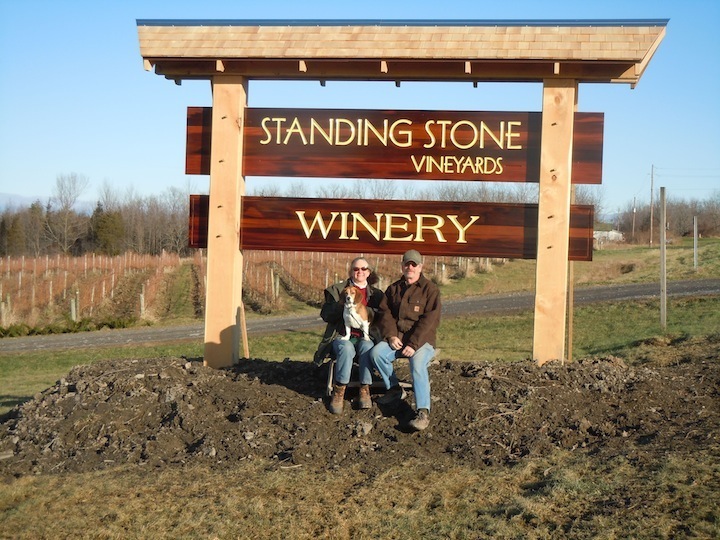
Tom and Marti Macinski Photo Courtesy: Standing Stone Vineyards

     As I read an interview with Oskar Bynke, co-owner of Herman J. Wiemer Vineyard where he revealed the vision he and co-owner/winemaker Fred Merwarth had for their newly acquired Standing Stone Winery and Vineyards I had to accept the fact that change is inevitable even in wine country. The release of the 2017 vintages from Standing Stone Winery marks the first time since 1991 that Tom and Marti Macinski were not the owners of this iconic FLX property.

In the 1970’s this former Gold Seal Winery vineyard was planted with Riesling and Chardonnay by the legendary Gold Seal wine makers Charles Founier and Guy Devaux. Standing Stone Chardonnay and Riesling have always been highly acclaimed but it wasn’t those world-class whites that lead to my friendship with Marti, it was the dark red Russian wine grape Saperavi. Had it not been for the time Marti took from her busy schedule to answer my questions and keep me updated on her Saperavi program I would have never pursued my interest in Saperavi or have made as many friends around the world who also share my love of this extraordinary wine.

Thank you Marti and Tom for your devotion to making the best wine from the best grapes you could grow on the land you truly love. Please know that like the wake from a sailboat (that you now have time to enjoy) the ripples of your life’s work will be felt far beyond the shores of your beloved Seneca Lake.

The Shape of Wine

     The theme of the Oscar-winning movie of a similar name was that something could be completely different and yet possess qualities that could make you fall in love. Chateau Niagara Kagor 2016 is just such an animal.

Jim and Cathy Baker make their Kagor from Saperavi grapes grown in their vineyard on the Niagara Plain in Newfane, NY. Kagor is traditionally made from Cabernet Sauvignon grapes but its name comes from Cahors, France where the predominant grape variety in French Cahors wine is Malbec. Kagor is best described as a red dessert wine with a very long and interesting history. 

Jim Baker describes his Chateau Niagara Kagor 2016 taste profile as  “Decadent, lush rich cherry that morphs into cassis on the tongue. A sweet wine that pairs well with dark chocolate.”

     Jim gave me very detailed instructions on how to taste his Kagor. He told me to be patient with this wine and give it time to develop its flavors by waiting until they all were revealed, then taste it again over fine dark chocolate for a cherry cordial profile.

     Chateau Niagara 2016 Kagor won Bronze at the inaugural 2017  Saperavi World Prize (SapPrize) wine completion in Tibilis, Georgia (Russia). Chateau Niagara Kagor 2016 and all the Chateau Niagara wines are available at  http://chateauniagarawinery.com