A Winelovers Guide to Western Pennsylvania Wineries Part 3

This is Part 3 and the final installment in my series featuring Western Pennsylvania wineries. All the wineries from previous posts will be included for reference or if you are new to my blog. I invite everyone to subscribe for free to this blog using the subscription box at the top of this page. You will receive an email when I publish a new article. Thanks. 

Pennsylvania is home to more than four hundred wineries and over fourteen thousand acres of vineyards. Some of the very best are located on the western side of the state. The wineries are as unique as the wines they make. The following suggestions are just a starting point. The real fun comes in exploring all this region has to see and do.

Driving twenty-three miles south of Pittsburgh will bring you to Silver Mark Cellars. It is an urban-style winery in the charming town of Canonsburg. They offer an award-winning wine list complemented with food, beer, and liquor. All of their wines are handcrafted in-house from start to finish. http://silvermarkcellars.com 724-416-7447

Nestled in the picturesque rolling hills of Westmoreland County near Acme we find Stone Villa Wine Cellars. Guests can relax on the manicured lawn surrounding a tranquil lake while listening to live music. Stone Villa Wine Cellars offers a portfolio of wines ranging from classic to unique blends that are sure to satisfy everyone’s tastes. As always, the tasting bar is free. http://stonevilla.com 724-423-5604

Situated on the remaining three acres of the old “Martz Family Farm” in Delmont stands a barn originally built in the 1860s that now serves as the home of Red Barn Winery. Red Barn Winery makes sweet and dry wines from grapes sourced from several regions. It also offers Pennsylvania beers and spirits, food, entertainment, and special events. http://redbarnwinerypa.com 724-461-4331

Thistlewaite Vineyards only use the French hybrid grapes they grow in their five-acre vineyard to produce their wines. They age their wine in Pennsylvania White Oak barrels or stainless steel tanks. When you are in Jefferson stop by the tasting room for a complimentary wine tasting. http://thistlegrape.com 724-883-3372

Edgewood Winery and Event Center in Spring Church is a one-stop shop for all your entertainment needs. They sell their wines by bottle or glass, have a food menu sure to please everyone, an event calendar full of live music, and plenty of options for your special event. http://edgewoodwinery.com 724-478-4373

I hope you enjoyed reading these articles as much as I enjoyed researching and writing them. Please use these suggestions to start your journey to discover the constantly evolving community of wineries in Western Pennsylvania. Cheers!

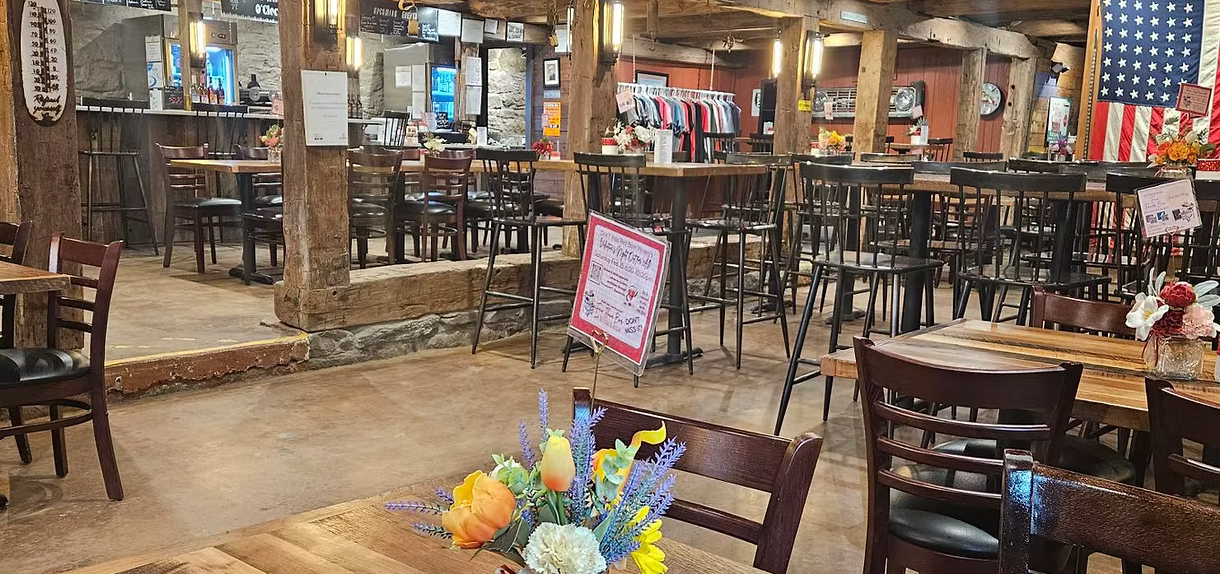
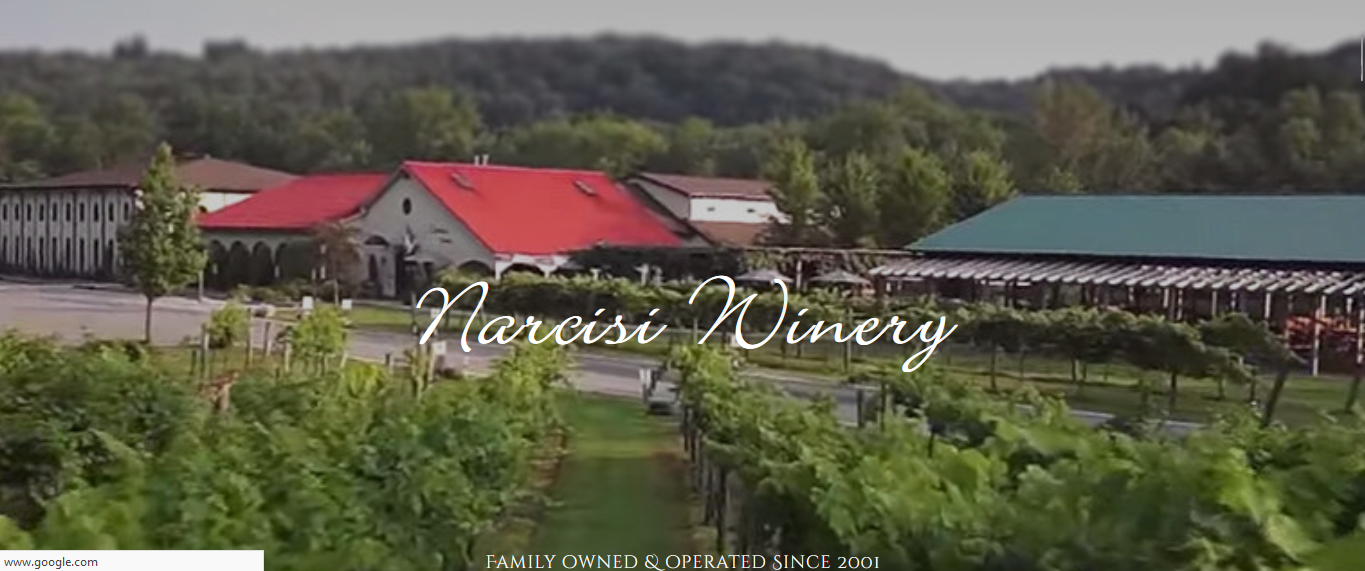
Photo Credit: L to R Silver Mark Cellars, Red Barn Winery, Thistlewaite Vineyards

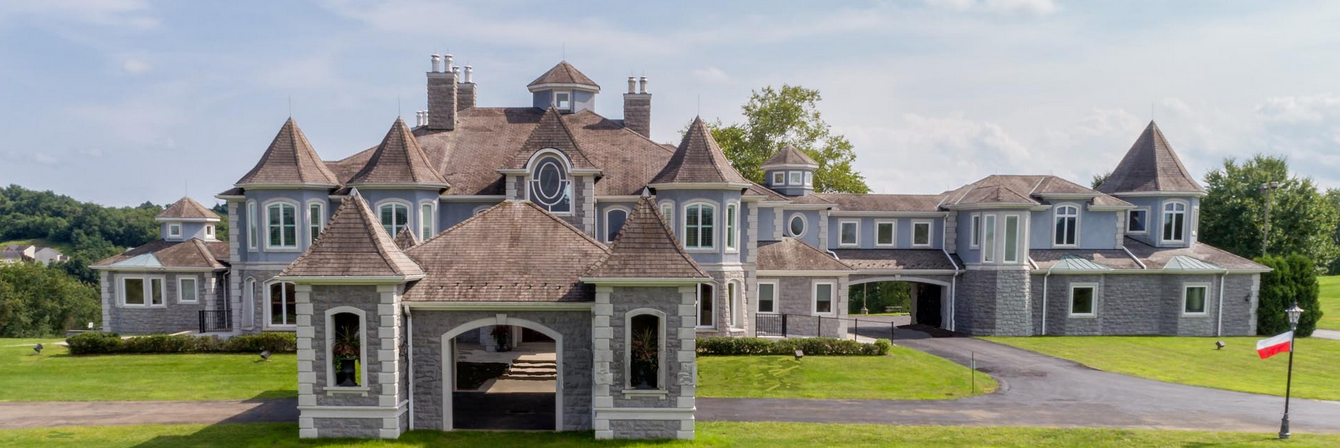
We’re off to see “The Castle”. The Vinoski Winery is located in the magnificent Rostraver mansion Jay and Sherry Lustig built. Jay was the long-time manager of The Rolling Stones, financial advisor to Prince Rupert Loewenstein, and later became a minority owner of the Pittsburgh Pirates. Walt and Roxanne Vinoski bought the sprawling property in 2017 and turned it into the breathtaking home of the Vinoski Winery. They offer two wine tasting options: $10 for 5 sweet wines or a Premium tasting for $20 that includes their dry California wines. Check their website for the event calendar which is always full of concerts and events. http://vinoskiwinery.com 724-872-3333

Let’s not forget about our friends north of Pittsburgh. The next stop is the picturesque Tuscan-inspired winery and restaurant of Narcisi Winery. A short ten-mile drive north of the city will bring you to Narcisi Winery in Gibsonia. Set on an enchanting property, this Italian-themed winery and restaurant will satisfy anyone’s longing to spend a “Bella Giornata” (Beautiful Day) in Tuscany.  http://narcisiwinery.com  724-444-4744

Any time of year is a good time to take a leisurely drive to Glades Pike Winery near Somerset on Pa State Rte 31. It will take you past several notable attractions for the outdoor enthusiast.  The Seven Springs and Hidden Valley ski resorts plus Laurel Hill and Kooser state parks are easily accessible from Glades Pike Winery. Glade Pike Winery makes a diverse selection of wines that will intrigue any wine aficionado. Malbec, Baco Noir, and Tempranillo are some of the unusual wines offered that are not readily found at other local wineries. http://gladespikewinery.com 814-445-3753 

The Original Pittsburgh Winery is an urban winery and as such it can make its wines year-round because they source their grapes from vineyards in California and Chile. Swing by the winery on Liberty Avenue in Pittsburgh’s Strip District to taste their wines, grab a bite to eat, and enjoy live music in an intimate setting. http://pittsburghwinery.com  412-566-1000

Guests at Ripepi Winery & Vineyard in Monongahela can enjoy a tranquil ten-acre vineyard from the Tuscan-inspired winery as you savor a glass of their estate-made wine.  Owner/winemaker Rich Ripepi founded his landmark winery in 1987. Today it is a family legacy he shares with his winemaker/sommelier daughter Janelle Ripepi D’Eramo and winemaker son Dr. Daniel Ripepi. They host a fun “Happy Hour” event every second Friday of the month. http://ripepiwine.com 724-292-8351

Traveling to Mount Pleasant you will find Greendance The Winery at Sand Hill. Greendance Winery is part of the Sand Hill Berries, a small family-owned business that specializes in different types of berries, especially raspberries. You might recognize them from their raspberry specialty desserts booth at festivals. The winery and its grounds are set in the idyllic Laurel Highlands countryside. Stop by anytime to enjoy the rural ambiance but if you visit on a summer weekend you will be treated to live music as you unwind with a bottle of their wine. http://greendancewinery.com 724-547-6500

Up we go into the Allegheny Mountains to Chalk Hill where we arrive at Christian K. Klay Winery. A visit to Christian K. Klay Winery and its adjacent Ridge Runner Distillery is sure to include wine, spirits, and beautiful vistas. http://christianklaywinery.com 724-439-3424

Bella Terra Vineyards in Hunker is easily accessible and has ample parking plus plenty of inside and outside areas making it a favorite meeting place for friends and family. Check their website for the many special events on the calendar. http://bellaterravineyards.com 724-635-3658

If you are looking for a twist on your usual night out then the City Winery is the place for you. Unlike the other wineries mentioned, City Winery is on Smallman St in Pittsburgh’s “Strip District”. It is a winery, restaurant, and event center that promotes live music, comedy shows, and wine events. http://citywinery.com/pittsburgh 412-246-1000

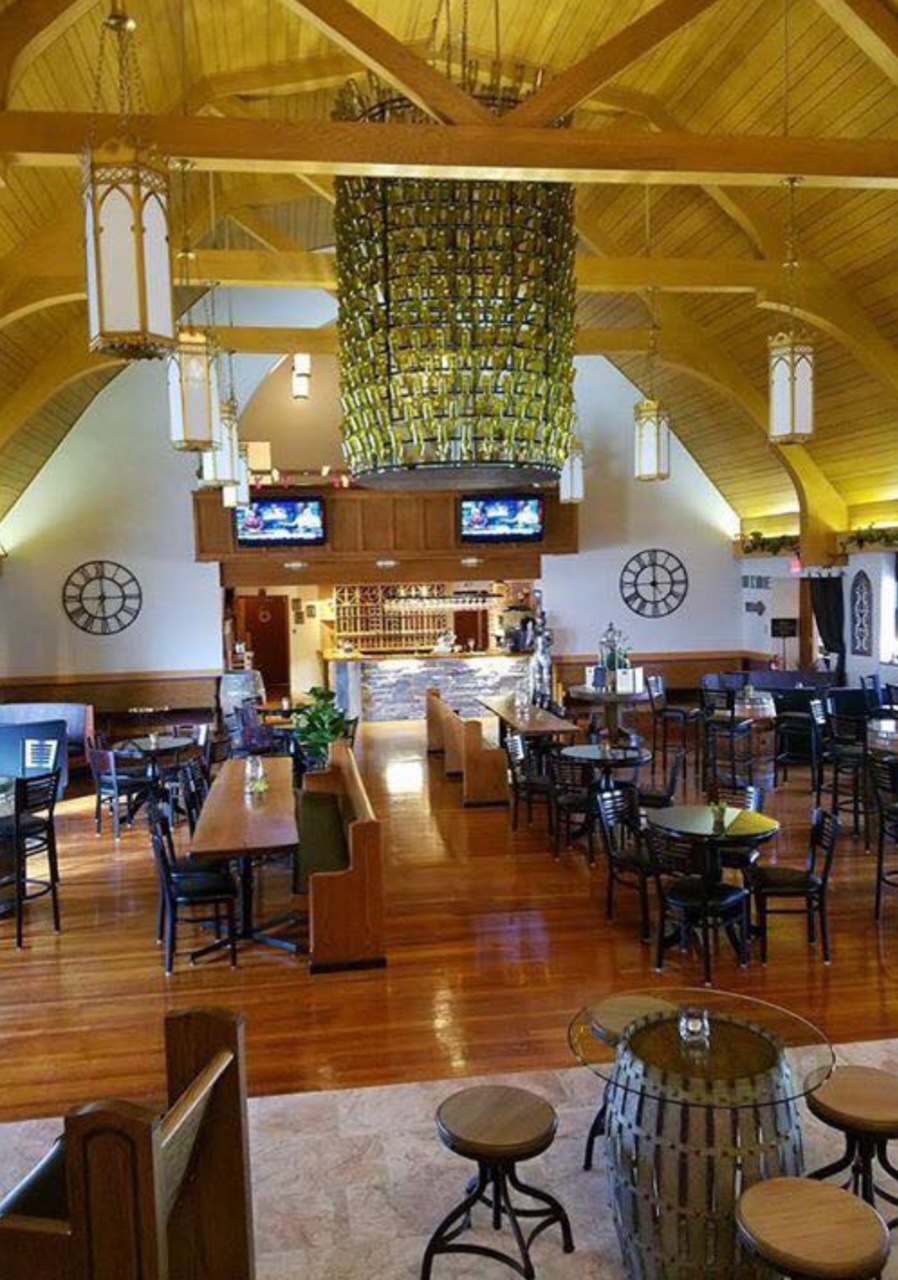
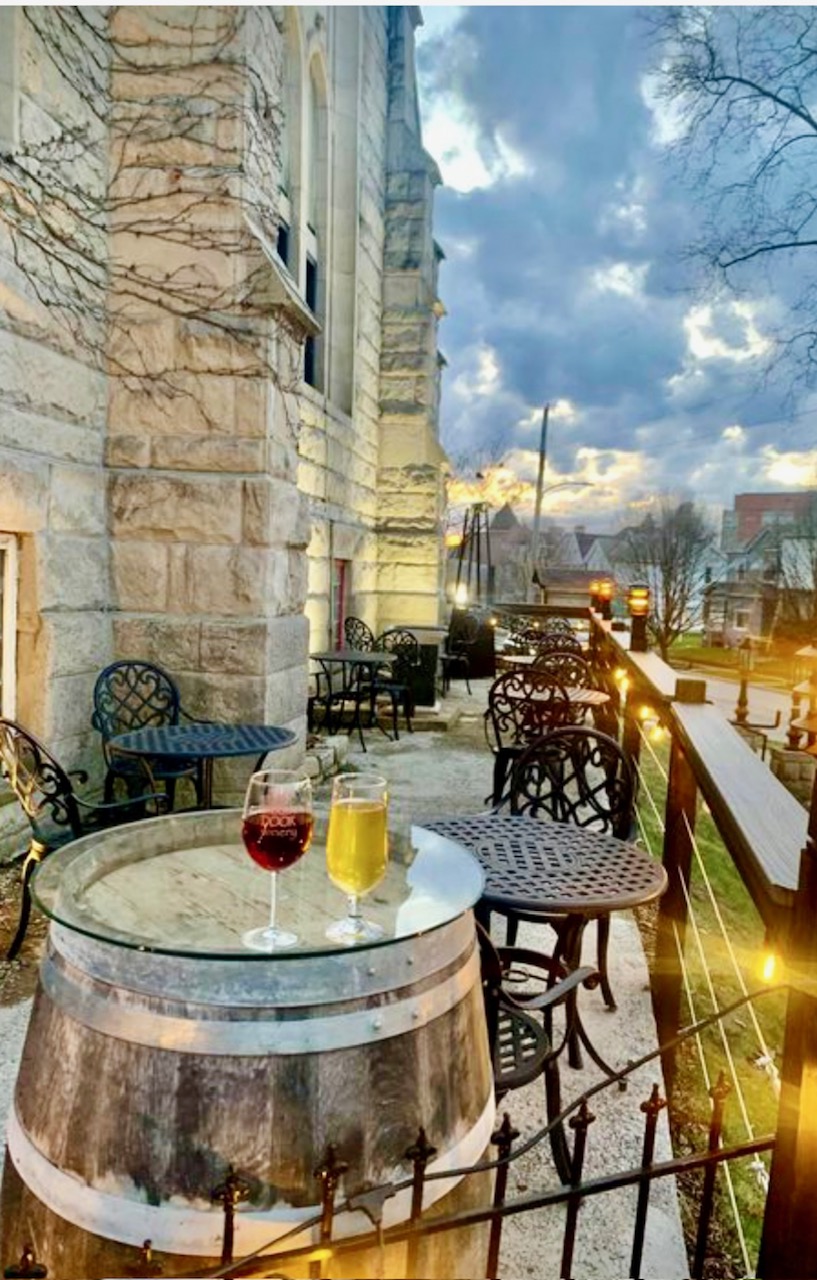
Wooden Door Winery is located in a painstakingly renovated 1896 church in Vandergrift. Explore their diverse lineup of wines while sampling a menu of appetizers and lighter fare in the spacious tasting room or the al fresco seating during the warmer weather. http://woodendoorwinery.com 724-889-7244
How To Propagate Grapevines From Cuttings

The following article is a collaborative effort between myself and Stephen Casscles, a leading authority on the propagation and cultivation of cool climate and heritage grapevines. It is a detailed account of the procedures for propagating new grapevines from the cuttings of an existing vine. Thank you Steve for being so generous with your time and knowledge. All photos in this article are courtesy of Stephen Casscles. If you need more information about how to propagate vines, consult older books written by Philip Wagner, which are still available, or contact your local cooperative extension agent who can direct you to excellent brochures that have been produced by your local agricultural state university.

If you have or can obtain clippings from a grapevine that produces excellent fruit, it is easy to reproduce as many vines/clones of that vine as you want. Starting new vines from the clippings of a mother vine ensures you will grow an exact copy of the vine and it will crop the same quality grapes as the original vine. Be sure that the mother vine that you select for your cuttings is a strong vine, that exhibits no indications of viruses or diseases. Vines that have curled leaves, odd-looking clusters, or off-leaf colors could have been contaminated with a virus. Do not use these vines as you are simply propagating diseased and virus-laden vines and not the strong virus-free vines that you want.

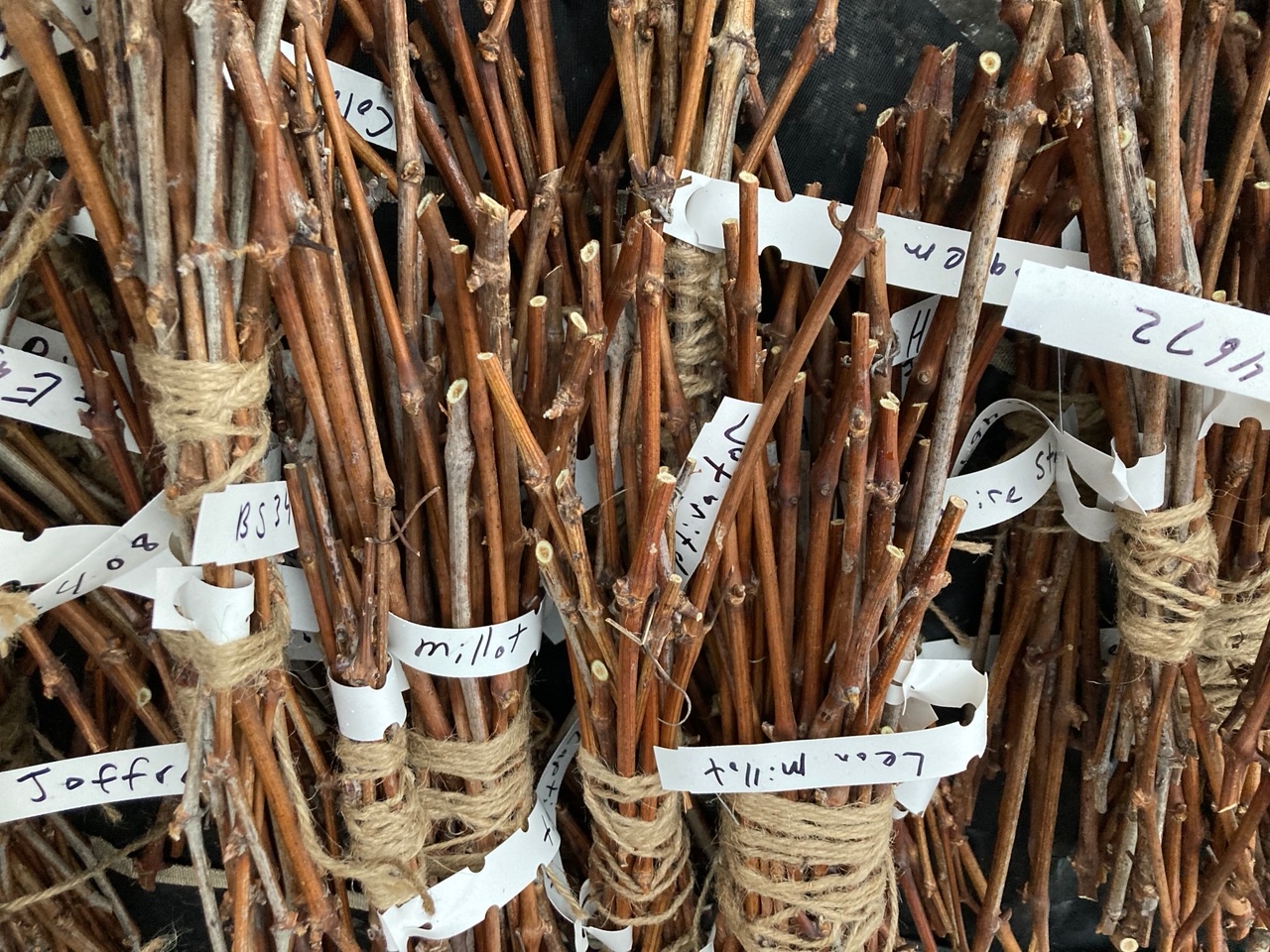
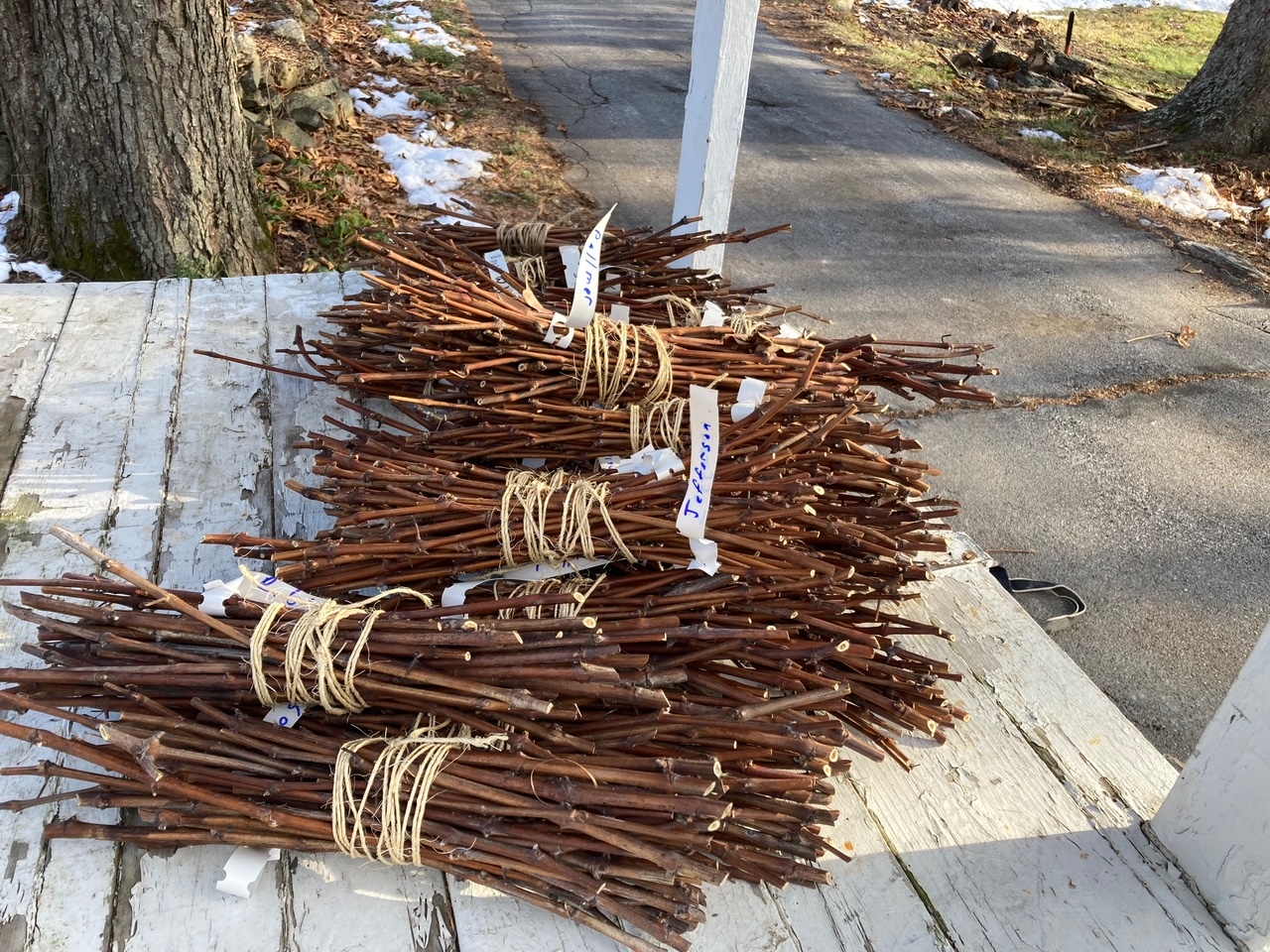
Propagating new grapevines from cuttings is an easy project. First, you must gather your propagating wood in early Spring while the vines remain dormant. Cut 12-18 inch sections from one-year-old wood that is about the thickness of a pencil and has a minimum of at least four leaf bud nodes on it. Ideally, having five or six bud nodes per cutting offers the best chance of success. A leaf bud node will look like a small bump on the stem.

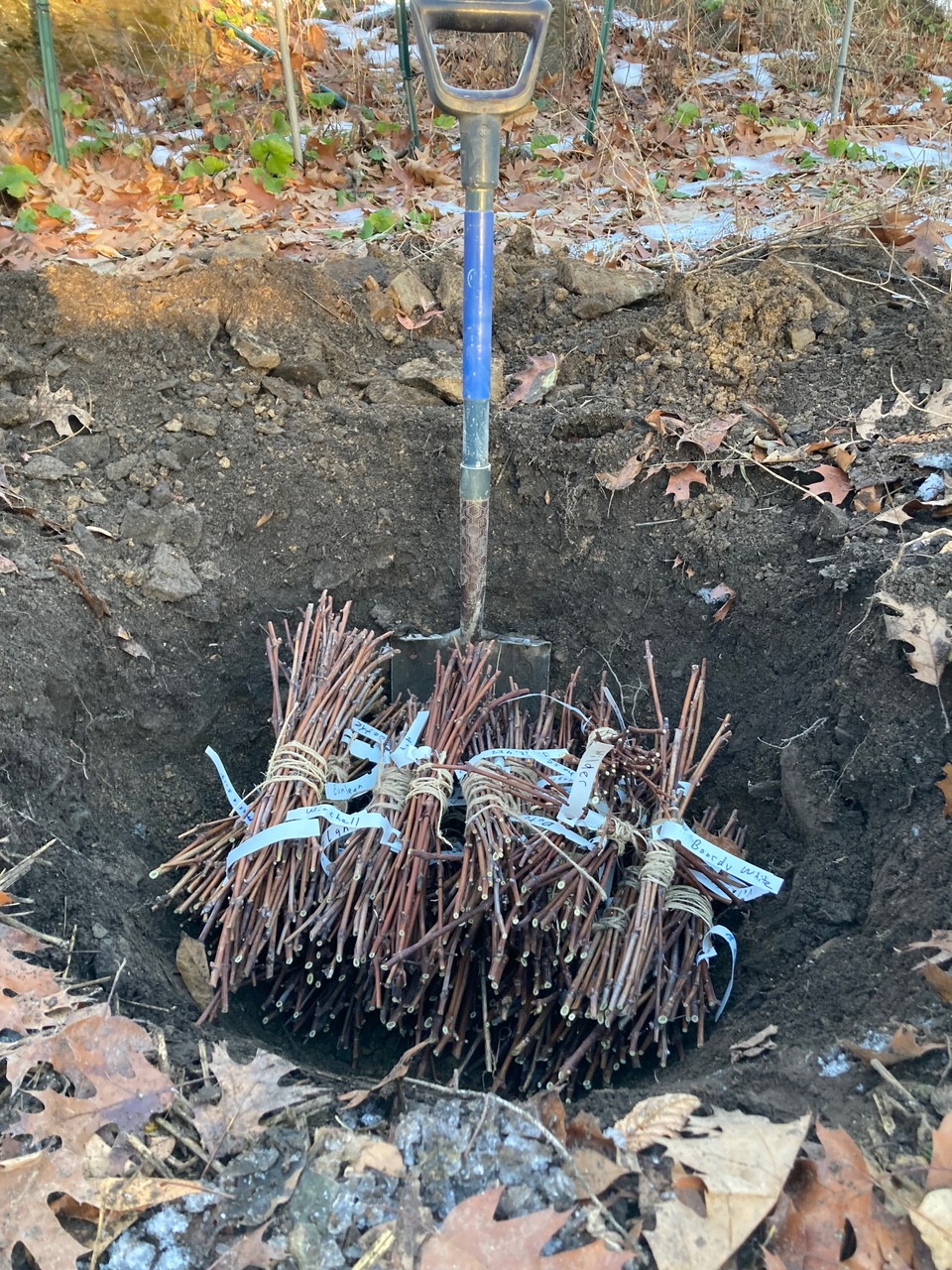
The next step is up to the propagator, but Steve said he was taught to nip off a straight cut one inch above the top bud and make an angled cut at the bottom of the cane just below the bud node. Making your angled cut at the bottom of the stem easily shows where the top of the cutting is from the bottom which makes it easier when setting out your nursery cuttings, it also allows the cutting to be easily planted in the soil. No matter how you cut your ends, make sure you are consistent so that you will always plant your cuttings correctly, bottom side down in the soil. Dipping the bottom end of the stem into rooting hormones is helpful in promoting root growth, but is not necessary. You can find rooting hormones at your local garden center or nursery. If you are only rooting a few cuttings, fill a potting container with your local soil, if it is good well-drained loam soil, if it isn’t mix it with potting soil to improve its drainage.  Make sure your container is deep enough to accommodate your clippings, but if you are propagating a lot of material consider digging a shallow trench and reserving enough loose soil to fill in around your stems.

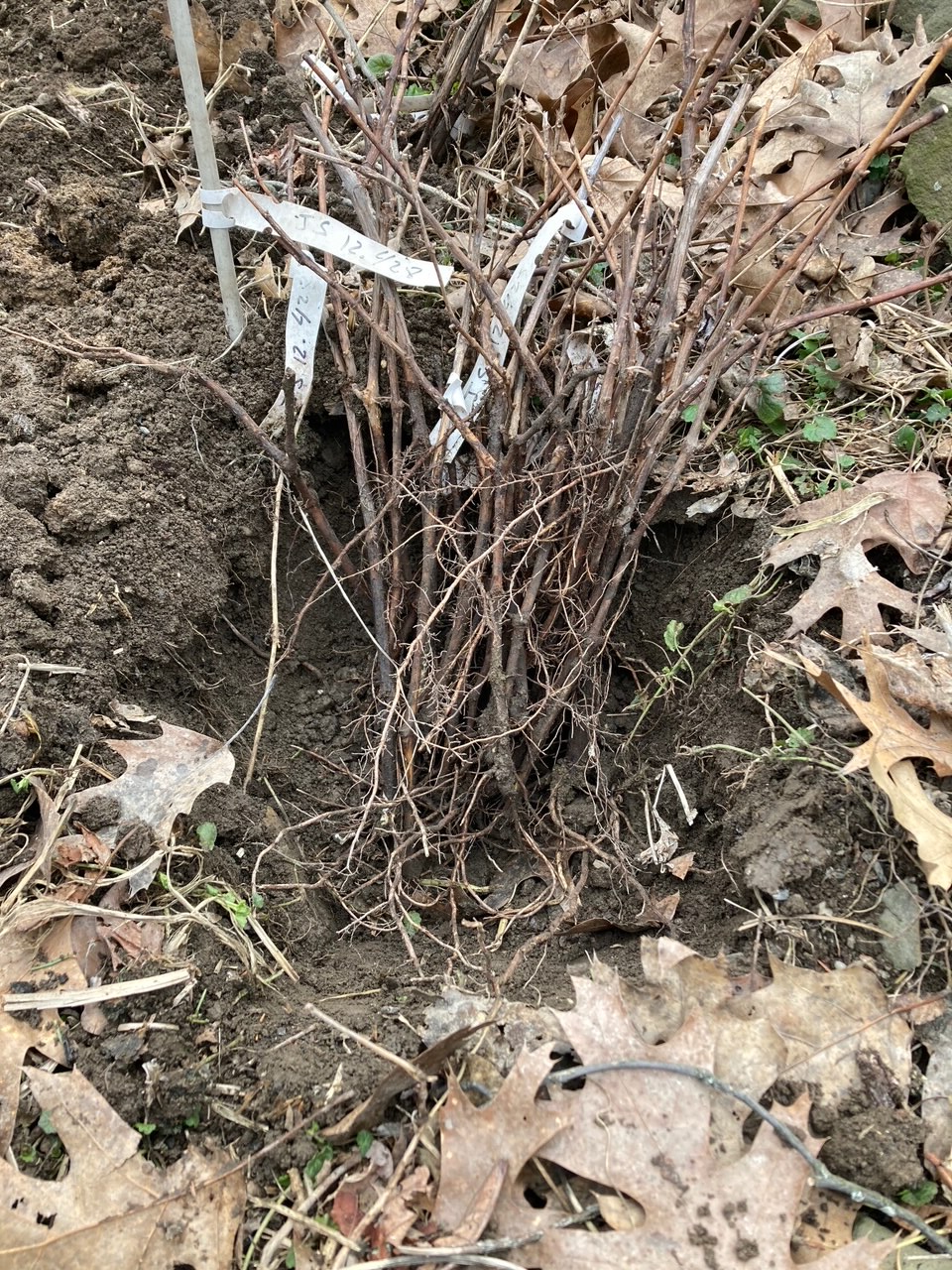
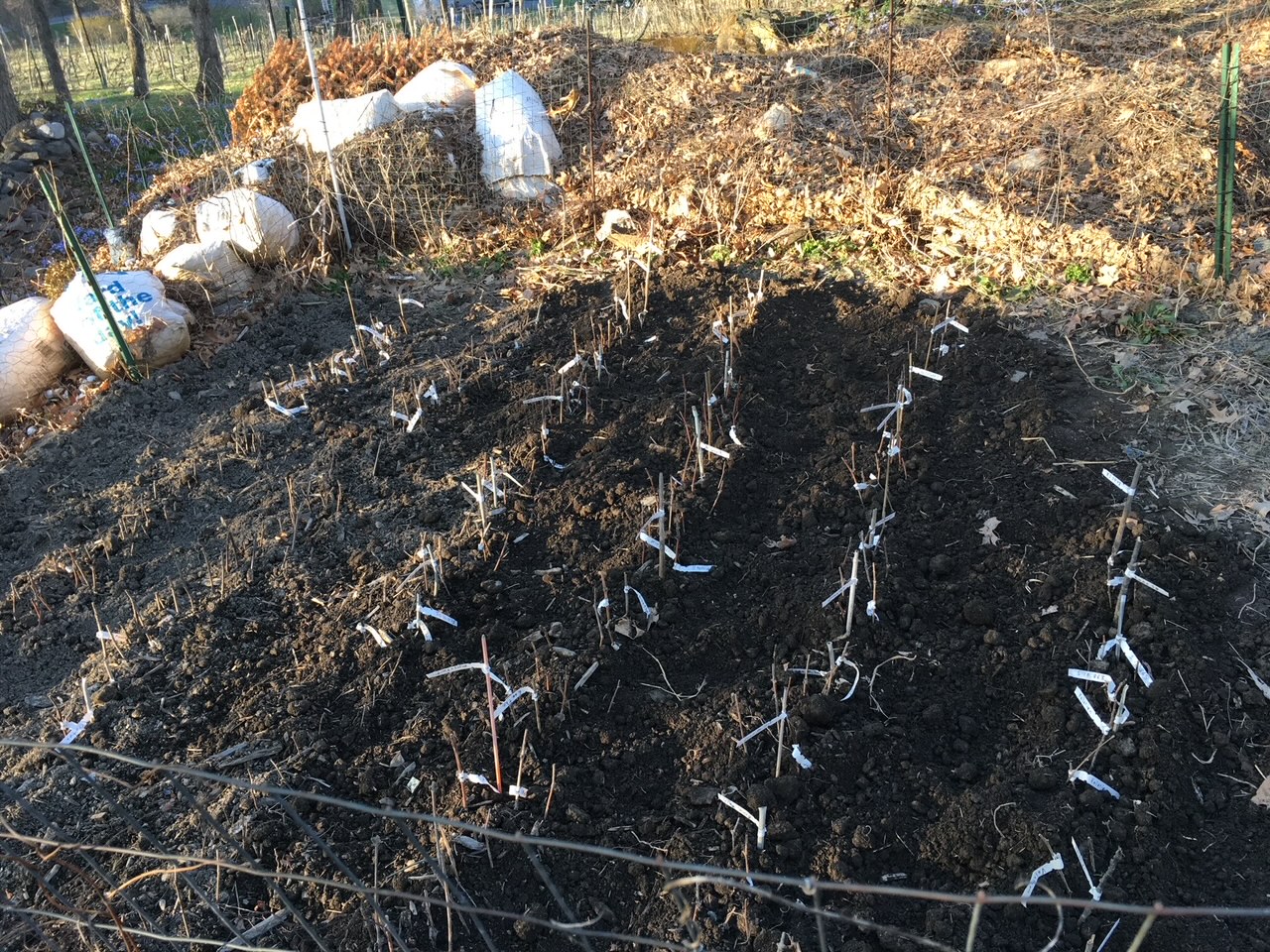
  These trenches can be located in your vegetable garden, since this soil has been worked up for many years, and often has a fence around it to keep out the wildlife that may like to browse on your newly installed cuttings. When planting your cuttings, bury them vertically three to four nodes deep with the bottom side down into the ground, leaving the remaining nodes exposed above the soil level. Remember to plant the bottom of the stem down with the straight-cut end above the ground.

    Keep the soil well watered, but not soggy throughout the first year when your cuttings are establishing themselves. For those in potted containers, the cuttings should be placed in a frost-free location with bright indirect sunlight. If you have more than one row of nursery cuttings in your nursery, it is recommended to mulch the cuttings with straw (not hay) to keep down the weeds and retain soil moisture.

Steve explained the difference between taking cuttings from your vine and propagating them as a single project and cloning in which you separate individual canes that have a certain desirable mutation to create an entirely new variety of the original grapevine. Steve gave me an excellent example that was easy to understand. “My understanding is that cloning would be finding an abnormal sport of a vine that is different and you cut that unique cane off to propagate it. For example, Frontenac Gris is only a regular Frontenac when it was noticed that a separate cane had bronze-colored grapes and not red.  So cloning would be separating and propagating that “clone”, but if you are propagating wood, you just collect your wood and go at it.”

    It is essential that you plant more cuttings than you need to compensate for some not surviving. As a dear departed friend of Steve’s, Joel Fry of the Bartrams Garden in Philadelphia used to say, “Plant two of everything, and one will die”.  How many to plant is the question? Steve offered his advice based on years of experience in this area of viticulture. “I find that different varieties propagate at different rates. For example, Baco Noir, which is a part Riparia variety tends to have a higher success rate because it is a Riparia. Even with Riparia, I would plan for a 20% non-success rate for varieties such as Delaware, which is a part Bourquinian species hybrid, do not take as readily, so I would expect a 40% death rate.”  I would recommend propagating as many cuttings as possible using only the strongest ones to satisfy your needs and giving the extras away. Vines can also be rooted in water, but you will need to change the water regularly to prevent disease. Once you see the stems/cuttings rooting, you must transplant them into the soil.

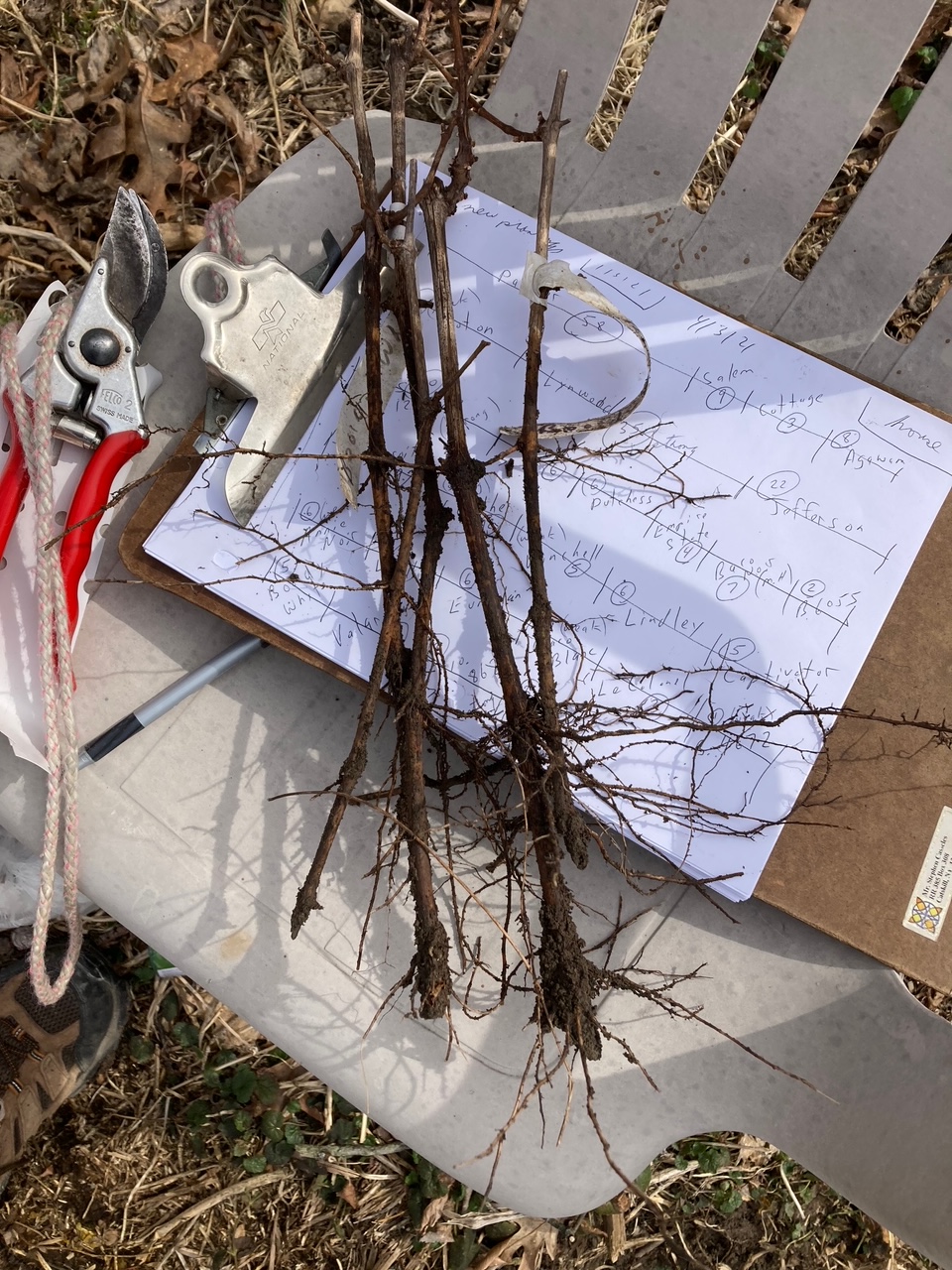
    Whether you set out a nursery in your home garden or place them in pots in the spring, you need to wait an entire year to ensure that your cuttings have sufficient roots before they are set out in the field the following spring. After your cuttings have developed a strong root system they can be transplanted to their permanent location. 

    You probably have heard vintners say the clone number for a specific variety of grapes planted in their vineyard. An example of this would be the Pinot Noir Dijon clones 114, 115, 667, and 777 which are the most widely planted Pinot Noir clones because of their reliability and productivity. When you drink any mass-produced Pinot Noir you are likely drinking wine made from these clones. It is easy to go down a “rabbit hole” when looking for clones of just about any grape variety when researching which clones to plant in your vineyard. Don’t let the sheer number of options overwhelm you. The answer to this question is a simple one, treat a clone like a different variety. Pick a clone you like and propagate that clone.

    Growing your own vines from cuttings is a rewarding venture both financially and from the sense of personal accomplishment you will feel when you harvest your first grapes. With the adverse effects of climate change being documented in vineyards around the world and the increased number of adverse weather events plaguing vintners, the answer to a  consistent and economically sustainable fruit crop may lie in the past with heritage grape varieties, older cool climate hybrids, and new hybrids that are being developed. Growing heritage and cool climate hybrid grape vines that have adapted to survive many weather-related challenges over time could be a critical puzzle piece in the future viability of our vineyards, for both hobby and commercial grape growers. In addition, these varieties tend to be more productive and can be grown more sustainably with fewer pesticide/fungicide applications. They are direct producers that do not need to be planted on a rootstock. This means that if we witness a very cold winter or late spring frost, which kills that part of the vine above the ground, canes will come up from the ground to produce a crop in the same growing season.

    With that objective in mind, Stephen Casscles continues to labor on his long-term project, the Cedar Cliff Vineyards Heritage Grape\Wine Project, aimed at preserving heritage and lesser-known cool climate grape varieties in Northern America. If you have any questions about his work at Cedar Cliff Vineyards please contact Stephen Casscles cassclesjs@yahoo.com  To further his work, Stephen has established a set of three cooperating nurseries in Marlboro, NY, Fonda, NY, and Ipswich, MA where you can purchase already rooted vines and/or grape cuttings. If you are interested in obtaining vines or cuttings of these unique varieties, please feel free to contact Stephen Casscles cassclesjs@yahoo.com.  Sadly, most of these cuttings or vines are not available at commercial nurseries, hence we need to propagate them on our own to increase the availability of these unique virus-free/ disease-free grape varieties. For additional information on these heritage and cool climate grape hybrids, the 2nd edition of Steve’s book “Grapes of the Hudson Valley and Other Cool Climate Regions of the US and Canada”  is available at http://www.flintminepress.com .  

What I Learned at The Symposium for Professional Wine Writers

Photo Courtesy: The Symposium for Professional Wine Writers at Meadowood Napa Valley

I recently attended The Symposium for Professional Wine Writers at Meadowood Napa Valley 2021 via zoom. The three day event was very informative and enlightening on many levels. The speakers and panel discussions were all presented by very knowledgeable and prominent members of the wine media. If you have a chance to participate in an event like this I would encourage you to do so.

I would like to share a few points the speakers emphasized that are certain to increase the likelihood of your work getting noticed and ultimately being published.

1) Keep pitches about two paragraphs long and make your case why they should publish it and why you should be the person to write it.

2) Write about what you know and be an expert concerning the area where you live.

3) After the initial pitch do one or two follow-ups and if there is no reply, move on.

4) Pitch a story that isn’t in print and is new.

5) When describing wine use references that are familiar to your readers. Example: You wouldn’t refer to cherry and blackberry flavors if you were writing an article for publication in Asia because those flavors would be unfamiliar to most of the readers there, instead use recognizable flavors like lychee, guava, mango etc.

6) Email remains the most effective way to submit a pitch and never use a DM (direct message) via social media to contact an editor and never never ever contact an editor saying “Hey, I’m going to (Tuscany or anywhere else) do you need anything?” They said that goes directly into the trash.

These are just a few things I learned over the course of the symposium. I hope these insights into the thought process of editors will help you when you are pursuing a writing career.

Homeward Bound

If you have followed this blog you know that I’m fascinated by uncommon wine grapes and where they are being grown by innovative vintners. I usually write about grapes that originated in other parts of the world but today I’m writing about a grape that was developed in the United States and is widely planted in my home state of Pennsylvania.

Traminette was created in 1965 at the University of Illinois by crossing the Vitis vinifera grape Gewürztraminer and the French-American hybrid grape Joannes Seyve 23.416. It was originally created as a white table grape but was then found to possess qualities that make it favorable for making wine. The result was a grape with a complex flavor profile, good productivity, resistance to cold temperatures, and versatility in the cellar. Traminette produces a straw-colored wine that has an enticing floral aroma and flavors of apricot, honey, and to a lesser extent, tropical fruit. I had the pleasure of tasting Traminette juice as it flowed from the press at Ripepi Wnery & Vineyard Monongahela, PA. It was bright and had a depth of sweetness with a flavor that is hard to describe. Traminette is most often made in a dry to off-dry style. I like both styles but prefer the off-dry wine when enjoying a day at the winery with my friends.

Traminette can be found throughout Pennsylvania but is most heavily concentrated in the southeastern and northcentral regions.

My Article in Michigan Uncorked

I would like to invite you to view my article about Saperavi in the Spring 2020 issue of Michigan Uncorked. An online version of the magazine can be accessed by going to http://michiganuncorked.com and clicking on the Spring issue link on the home page to read the free flip-page edition (I’m on page 6 + 7) or use this link to go directly to the front cover of the magazine http://online.fliphtml5.com/hllky/gjob/#=6This is an edited version of an article that appears in the Spring 2020 issue of the American Wine Society Wine Journal.

Thanks to Michigan Uncorked’s Editor-in-Chief Jim Rink for the opportunity to share my story with the readers of Michigan Uncorked. I hope you enjoy the article and it provides you a bit of relief from the uncertainty and stressful times we are experiencing. Be prudent and stay safe! 


Just Saying!!!

Here are a few of my views on recent trends.

I am not a big fan of bottle caps on wine bottles. I have no problem with screw tops or wine in cans but when I see a wine bottle with a cap on top I think back to my childhood and remember bottles of my favorite “Pop” Regent Cherry soda. In Western Pennsylvania carbonated soft drinks, like Coke and Pepsi, were and still are to a certain extent referred to as “Pop”. Maybe it was a shortening of soda pop that led to this regional slang.

Rosé has been riding a steadily ascending arc of popularity over the past several years. I have heard reports that Rosé sales hit their crescendo in the Summer of 2017 and have consolidated over the last 18 months. Although Rosé is thought of as just a summer wine by many it is a category that has proven itself and is here to stay. Traditionally Rosé sales peak during the warm months but year round sales are starting to rise as people realize that this wine pairs well with food in any season.

Orange wine is a curiosity to me because I like to try new things. It has received plenty of attention but I don’t know where it fits into the big picture when it comes to wine in general. We will have to wait and see if it will be taking a place in your wine collection or in the closet next to your Beanie Babies and Cabbage Patch Dolls.

My prediction for Chinese wine is that it is too early to tell if all the money China has invested in its domestic wine industry will pay off. There is certainly enough demand for better wine in China now that its middle class is expanding exponentially. In time I believe China will become a major player in the world wine market simply because it has a diverse collection of growing regions, climates, terroirs and affordable labor that can be developed. Will their wines taste like traditional European or New World wines? No, they will taste like those traditional wines made from grapes grown in Chinese soils and expressing a terroir unique to China.

Everyone has an opinion when it comes to sweet wine, French-American hybrid wine and Vitis vinifera wine. Every winemaker that I have visited in Western Pennsylvania is always eager to have me taste their dry wines but are quick to admit that it is the sweet wines that “Keep the lights on”. While it is true the sweeter wines make up the largest segment of wines sold in local wineries it is also true that interest in dry wine is increasing as tastes evolve and wine drinkers look for something new. I have always said that a “Good” wine is one you enjoy drinking. My theory is that many of the people who start going to wineries with friends will enjoy the easy to drink sweet wines and will be content with these wines. Some will become curious and explore the French-American hybrid wines, of which there are many and can be found in both dry and sweet styles. The wines made from French-American hybrid grapes can provide a bridge from sweet wines to Vitis vinifera wines. It is easier for a wine drinker to transition from the sweeter offerings to the drier Vitis vinifera wines by learning to appreciate the differences in wine grapes and the different styles that they can be made into by experiencing these approachable hybrid wines.

I believe wine is at it’s best when enjoyed while making lasting memories with friends and family. If you are doing it right you will always remember the good times and the people but you probably won’t recall what wine you were drinking.  Just Saying!


Rockin’ Down the Highway

     Just off Exit 146 of the Pennsylvania Turnpike at the foot of the Allegheny mountains lays the little town of Bedford. Nothing along the quaint business district in the center of town would give you any clue that something extraordinary is happening at 107 E. Pitt Street. That is the address of the tasting room for Briar Valley Vineyard & Winery, one of the best wineries in Pennsylvania. You might think that’s only my opinion of their classic European-style vinifera wines but I have a second opinion from someone with creditability greater than my own, Mr. James Suckling! Yes, you heard right, that James Suckling the world-famous wine critic.

     At a recent tasting of more than 800 non-West Coast wines Mr. Suckling gave Briar Valley Chardonnay 2016

Briar Valley Vineyard & Winery Chardonnay 2016

a score of 92 points calling it “Concentrated and fresh, this is an elegant cool-climate Chardonnay with bright lemon and herbal notes. Very long mineral finish.” Quite a coup for Tod & Jean Manspeaker owners/wine makers at B.V. Mr. Suckling went on to award B.V. Lemberger 2016 an 89 point score and B.V. Cabernet Franc 2016 87 points. These two Reds are among my favorite Pennsylvania wines. It is easy to see why Tod & Jean have recently expanded their winery with a new production facility because when you make wine this good you will need extra capacity.

You can find these wines and all the other quality wines that Briar Valley offers at their tasting room in Bedford, Pa, online at http://briarvalleywinery.com or at many fine dining restaurants around the state.

2015 Seven Springs Wine Festival

Wine

     The 2015 Seven Springs Wine Festival will be held August 28th through the 30th at the Seven Springs Mountain Resort Champion, Pa. With paid admission you can enjoy complimentary tastings from 31 Pennsylvania wineries with your free souvenir wine glass along with wine-themed seminars, live musical entertainment and other interesting attractions. A 5 p.m. – 9 p.m. Friday night session has been added this year in addition to the regular 11 a.m. – 5 p.m. hours on Saturday and Sunday. More information and the option to buy tickets can be found at the Seven Springs Resort website. www.7springs.com/events/wine-festival/ 

On the Edge of Glory

Fero Logo     I talked with Chuck Zaleski of Fero Vineyards & Winery in Lewisburg, Pa recently and got the inside story on “What’s New” at his winery.  When I asked about the 2014 harvest his voice filled with pride and excitement saying it was a record year in both quality and quantity.  The harvest was so good that he even sold some grapes this year.  It is a good thing that his vineyards are producing extraordinarily well because Chuck was planning on sales growth of 20% last year but it came in at 30%.  This year he will hold growth to 20% because his focus is always on the quality of the wine being maintained and improved.  Fero is the only producing Saperavi vineyard in Pennsylvania and Chuck’s plan is to double his acreage of Saperavi grapes as soon as he can acquire the vines.

Fero will be adding three new sweet wines to the menu this year.  The apple, cherry and peach wines will be made from the same Grüner Veltliner grapes grown in their vineyard that produced a Double Gold medal winner at the 2015 Pa. Farm Show.  Chuck makes great sweet wines but his real passion is for his excellent dry wines.  The judges at the 2015 Pa. Farm Show awarded Fero Vineyards & Winery 8 medals, they are: Double Gold: Grüner Veltliner , Gold: Pinot Gris, 3 Silver: Reisling, Pinot Noir and Saperavi and 3 Bronze.

This year’s fund- raising schedule is nearly full with only a very few dates still available.  New this year will be the Wine-N-Mile on May 29th.  This event is similar to a Beer-N-Mile where runners race a figure 8 course through the vineyard stopping at six stations to drink 2 ounces of wine at each.  After the race guests are invited to stay for live music and the summer “Happy Hour” kickoff.

If you would like more information about Fero Vineyards & Winery wine or events visit www.ferovineyards.com or call 570-568-0846

Ripepi Winery & Vineyard

Ripepi logo

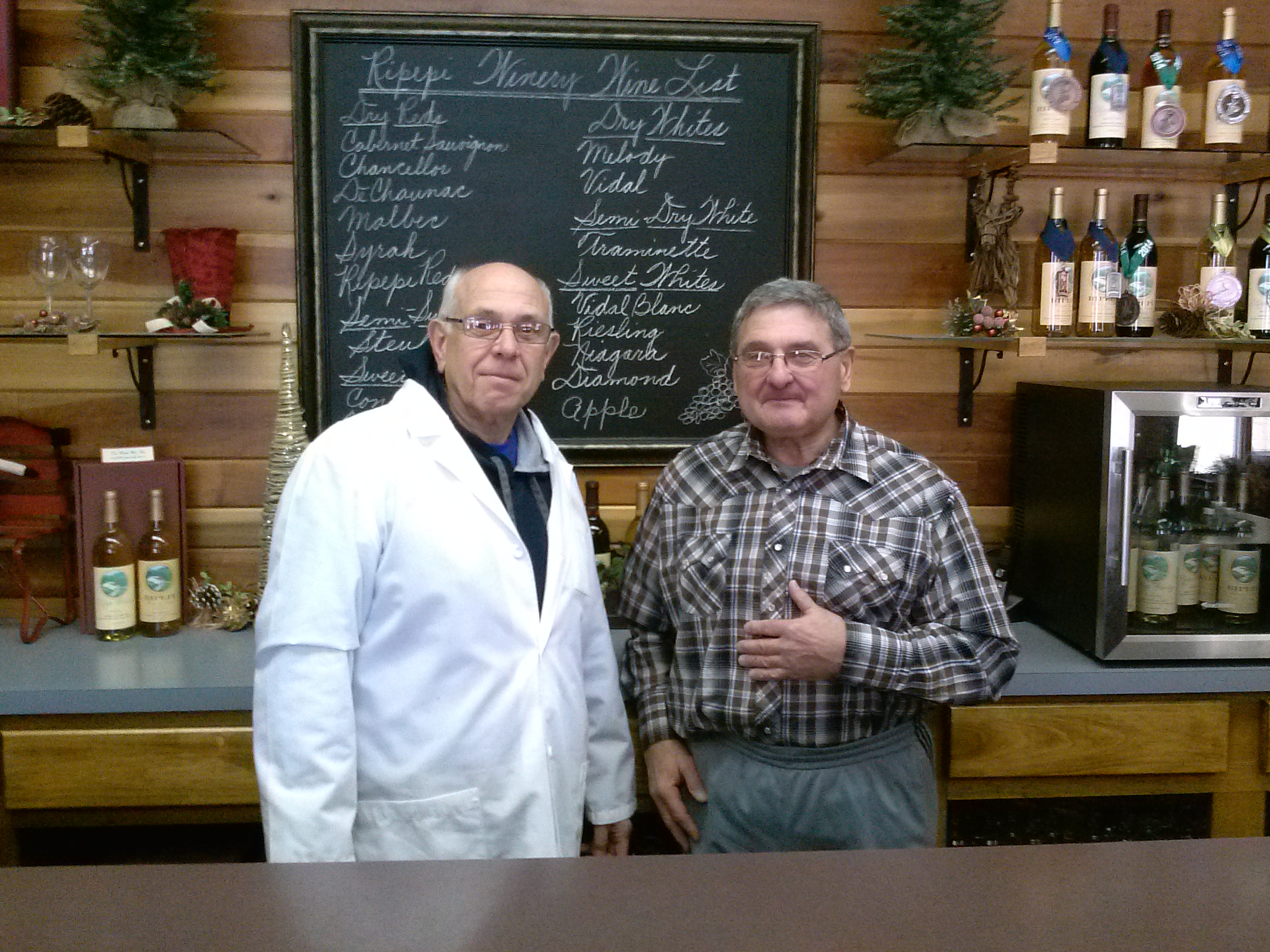
Winery Manager: Chuck Abvulovic (L) Owner&Winemaker: Rich Ripepi(R)

Winery Manager: Pete Abvulovic (L) Owner&Winemaker: Rich Ripepi(R)

     When you think of leaders in the resurgence of winemaking in Western Pennsylvania one name that should immediately come to mind is Richard Ripepi and his Ripepi Winery & Vineyard in Monongahela.  Rich showed great foresight when he founded his vineyard in 1987.  Those initial rows of grapes have now grown into a 10 acre vineyard containing nearly 5000 vines made up of 21 different varieties of wine grapes. 

     The day I visited Rich I found him to be the same welcoming and gracious host that I have come to know over the years, the kind that always makes you feel like one of the family.  While sitting in his tasting room I took the opportunity to ask him how the 2014 season had played out.  He told me it started out in early March with him leaving on extra buds because that was the consensus last year due to the extreme winter we had just experienced and the excepted damage it had caused to the vines.  In reality his vines sustained little if any damage with the exception being his Cabernet Sauvignon that required some vines to be replaced because of winter damage.  The spring brought rain and extra growth that prepared the vines for a huge volume of fruit to be set.  After June 10th normally the grapes should on the vines signaling it is time for the nets to go up and the spraying program to end.  It rained hard all summer and because of that the spraying had to continue to protect the crop.  By late August the vines were so laden with fruit Rich had to decide whether to drop a portion of the fruit or roll the dice on perfect fall weather.  Rich went with rolling the dice and he won.  September had abundant sunshine and little rain making conditions favorable for all of his grape varieties to ripen within a 3 week picking window instead of the usual 6 week harvest season.  Rich was both surprised and delighted with the resulting harvest that was the most bountiful and high quality of any in the history of Ripepi Vineyard.  Vines that usually average 7 to 8 pounds of fruit each produced 10 to 12 pounds per plant in 2014. 

     Work at a winery may slow in the winter but it never stops.  During my visit they were moving 800 gallons of wine outside to cold stabilize while Winery Manager Pete Abvulovic was in the lab working to find the alcohol content of various wines.  Decisions were being made on which Ripepi wines would be sent to the Finger Lakes International Wine Competition (F.L.I.W.C.) and which would be entered into the Pennsylvania Wine Association (P.W.A.) competition. 

     Rich honed his wine making skills by attending conferences and workshops sponsored by various universities and wine industry organizations.  During the early days of his winery he was helped immensely by two people that he met at these gatherings.  Rich made a special point to acknowledge the invaluable help given to him by his friends and viticulture experts, the late Robert Pool of Cornell University and the late Dr. Garth Cahoon of Ohio State University. 

     No trip to Ripepi Winery & Vineyard would be complete without tasting wine.  I tasted his award-winning DeChaunac, an excellent Merlot-like Chancellor and the 2013 Cabernet Sauvignon.  The Cab was especially enjoyable because it contained grapes that my wife and I helped pick during the 2013 harvest that was featured in my post ” Harvest at Ripepi Winery “.  For more information go to www.ripepiwine.com or follow him on twitter at @RipepiWinery     Phone: 724-288-3738