Saperavi World Prize 2017 Results

Photo Courtesy: Hvino News

The results are in from the inaugural Saperavi World Prize 2017 wine competition in Tibilis, Georgia. There were entries from seven countries and several continents with the most samples being submitted by Australian wineries. The three Grand Prize winners were awarded either a gold, silver or bronze miniature “azarpeshas“, the ancient Georgian drinking cup. Congratulations to the winners and all the participants of the 2017 SapPrize.

     Tastings were held on December 15th in Tibilisi, Georgia at the headquarters of the International Chamber of Commerce. The competition is open to producers outside of Georgia who make wine from the Saperavi grape. Entry is free and judging is conducted by an international jury of wine experts. This event was not conceived to be solely a wine contest but to become a forum for wine makers to interact and forge new relationships where they could share information and experiences to advance the understanding and quality of Saperavi wine worldwide.


SapPrize Grand Prize winners received miniature “azarpeshas”

It is always challenging to plan an award ceremony of this significance. The SapPrize award presentation had to be rescheduled when the American Ambassador couldn’t attend because of the “Shutdown” of the U.S. government due to the budget bill failing to be approved.

     Grand Prize Gold: Cirami Estate 2015 Saperavi from Australia. “The Gold Azarphesha” was presented to David Kereselidze, Director of Department of Asia, Africa, Australia and Pacific Rim of Georgian Embassy in Australia, he will present it to the winner in Canberra. Cirami Estate isn’t a winery but a non-profit organization called “Riverland Vine Improvement Committee”.

     Grand Prize Silver: McGregor Vineyard Black Russian Red 2010 Saperavi from the U.S.A. “The Silver Azarpesha” was presented to Elizabeth Rood, Charge d’ Affaire at U.S. Embassy. The Embassy will deliver the award to winner John McGregor in the U.S.A. John McGregor commented ” We are so honored to receive such recognition. We planted these grapes in 1980 and were the first commercial producer in the United States. It is wonderful to see confirmation of my father’s belief that Saperavi could grow in New York and make world-class wine”. John also won Silver for his 2011 Black Russian Red and 

John McGregor holds two bottles of his award winning Black Russian Red Saperavi

Bronze for his Black Russian Red 2013 Barrel Reserve.

Grand Prize Bronze: Lagyl Arba Saperavi 2013 from Kazakhistan. “The Bronze Azarpesha” was presented to Gulmira Sultanali, Charge d’ Affaires of Kazah Embassy.

Congratulations to Jim and Kathy Baker owners/wine makers at Chateau Niagara in Newfane, New York for being awarded Bronze for their Chateau Niagara Kagor 2016 made with Saperavi  from their vineyard.                   

I would like to say “Thank You’ to Inge Olsson of Hvino News for including me in the SapPrize and I enjoyed working with you on this project.  For more information on the Saperavi World Prize and a list of all the participating wineries go to  sapprize.hvino.com           

Grand Gold Prize winner Cirami Estate Saperavi 2015 from Australia

Elizabeth Rood, Charged d’ Affaire of U.S. Embassy accepts Grand Silver Prize for McGregor Vineyard


Time Traveler: Saperavi

     I wrote this article as a guest post for Anatoli Levine’s wine blog http://talk-a-vino.com under the title “Desperately  Seeking Saperavi”. I have updated it to keep my readers current with the evolving story of Saperavi.

The vintners of the Northeastern United States have long searched for a red wine grape that could be their signature grape. Over the years several have been on the cusp of becoming the iconic red wine grape that would be identified with the region for producing world-class red wine. Vintages of Lemberger and Cabernet Franc have produced stellar wines that can hold their own with other regions but just couldn’t elbow their way through a crowded field of reds to command the attention of the wine drinkers of the Eastern U.S. and beyond. The fact that you are reading this post proves that you are curious about something new in a world full of wine that can be overwhelming at times. The following is a summary of information I have gathered over the years about this intriguing grape from the wine makers and vineyard managers who know it best.

Saperavi is an ancient grape that can trace its origin to the Kakheti Region of Georgia and  surrounding regions as far back as 6000 B.C. Saperavi is a teinturier-type grape, which means it has a dark skin and a pink-tinted flesh. A teinturier variety of grape will produce an intensely colored juice when crushed because both the skin and flesh contain the water-soluble pigment anthrocyanin which is responsible for giving fruits and vegetables their red, blue and purple color. Saperavi is a very adaptable loose bunch, late ripening, cool climate grape variety that can produce large yields without sacrificing much fruit quality. These vines are able to thrive in cool climate regions even at high altitudes because they have above average resistance to cold temperatures. A more cold/frost tolerant hybrid called Saperavi Severny has been developed by incorporating genes from the hardy Severny grape. Traditionally Saperavi wine has been blended with lesser wines but recently it has gained popularity as a varietal bottling. A common translation of Saperavi is “dye” because it makes an extremely dark-colored wine. Saperavi wine is known for having good acidity and firm but not overwhelming tannins. It is these attributes that make it a wine that takes well to aging with some examples being found to have aged nicely for fifty years. Georgia recently has had political problems with its neighbors over the export of wine, notably Saperavi, but that is blessing because it is diverting more wine to the world market.

When talking about Saperavi I can’t contain my excitement and expectations for the wine being grown and made in the United States. I have coined the term “New World Saperavi” for the wine being grown and made by four wineries in the Finger Lakes Wine Region of New York, one on the Niagara Lake Plain in Northern New York and one in Central Pennsylvania. In the FLX Saperavi is being grown and made at Dr. Frank Vinifera Wine Cellars by Frederick (Fred) Frank, the son of Willy Frank and the grandson of Dr. Konstantin Frank, two legendary wine makers. Dr. Konstantin Frank was familiar with Saperavi from his research and work in the Ukraine before World War II. After the war he left Europe and brought his knowledge of growing vitis Vinifera grapes in a cold climate to the FLX where he revolutionized winemaking in the Eastern United States. Saperavi  winemaking is well established at Standing Stone Vineyards thanks to Martha (Marti) Macinski (owner/winemaker). She is one of the pioneers of Saperavi in the FLX and is making her wine using grapes from her ever-expanding Saperavi vineyard, arguably the largest in North America. In the Spring of 2017 Tom & Marti Macinski sold Standing Stone Vineyard to Fred Merwarth & Oskar Bynke, owners of Herman J. Wiemer Vineyard on the western shore of Seneca Lake in Dundee, NY. It is my understanding that the Standing Stone line of wine will be retained and that the Saperavi program will be continued. Anyone familiar with FLX Saperavi knows John McGregor at McGregor Vineyards, the maker of McGregor Black Russian Red. This wine is often refered to as “THE” cult wine of the FLX. McGregor Black Russian Red is a unique blend of Saperavi and Sereksiya Charni and is only produced at John’s Keuka Lake winery. Rob & Kate Thomas, owners of Shale Stone Winery produced their first vintage of Saperavi in 2014. They source their grapes from the Valois, NY vineyards of John Beckhorn. Shale Stone Winery will be planting a Saperavi vineyard in the Spring of 2018. The success of Rob & Kate’s Saperavi vineyard is assured because Shale Stone Winery is located right across the road from Standing Stone Vineyards. The old adage ” Location is everything” isn’t only true in real estate but also very important when growing wine grapes.

Jim & Kathy Baker planted 1/2 acre of Saperavi vines on their Niagara Lake Plain

Saperavi Grapes

property in New York five years ago. They used the grapes from that vineyard to produce Chateau Niagara’s newly released first vintage of Saperavi. This wine turned out so well that Jim is strongly considering adding substantially to his Saperavi vineyard. Jim also uses his Saperavi grapes to make a dessert wine called Kagor.  

The only Saperavi producer outside of New York state is Fero Vineyards and Winery in Lewisburg, Pennsylvania. Chuck Fero is the owner/winemaker at Fero and is experimenting with different wine making techniques and styles to capitalize on the distinct characteristics this grape exhibits. Fero’s Saperavi planting has grown to about an acre and is projected to yield about 4-5 tons of fruit. Chuck will turn that harvest into 300 cases of his award-winning Saperavi wine. 

Fero isn’t the only winery exploring the possible of Saperavi, all five of its counterparts in New York continue to hone in on their particular vision of what Saperavi can be and what styles it can be made into. Their success isn’t going unnoticed as more vineyard managers are planting Saperavi but the addition of newly planted acres is slow. There are several factors that have hindered the spread of Saperavi not the least of which is the scarcity of the vines themselves. White Barrel Winery (formerly Attimo) in Christianburg, Virginia has a young Saperavi vineyard that will be maturing in the next few years. Anyone considering adding Saperavi to their property can start their search at Grafted Grapevine Nursery Clifton Springs, New York a longtime supplier of Saperavi and other varieties to the wine industry.  http://graftedgrapevines.com 

The next stop on our search for “New World” Saperavi is Australia. South Australia to be more exact, home to Dan Traucki wine industry consultant, Director of Wine Assist Pty Ltd., freelance writer and my friend in the search for Saperavi wherever it may take me. Through his articles and our correspondences Dan has given me an insider’s perspective of the current state of Saperavi and other lesser known wines being made in Australia. Australian wine production from its nearly 4000 wineries is dominated by Shiraz and Chardonnay making completion for market share acutely competitive. Fourteen ground-breaking vineyard managers have taken the speculative position of planting Saperavi in their vineyards. The majority of these plantings are in the Barossa Valley and McLaren Vale Regions. Saperavi can also be found in the cool climate of the Alpine Valley region of Victoria. The cool climate Saperavi produces a slender wine with an angular taste profile while the warm climate renders a wine of muscular body and vivid taste. I helped  Dan with an international Saperavi tasting that he organized earlier this year. Dan collected 33+ samples of Saperavi from wine makers around the world and the results of the tasting confirmed that Saperavi is a rising star. The next big Saperavi competition is being held in Tbilisi, Republic of Georgia by the online publication Hvino News under the auspices of their publishing house Hvino News http://sapprize.hvino.com with the support of Georgia’s National Wine Agency. The “Saperavi World Prize” is open to non-Georgian producers worldwide and is free to enter. 

I am interested in how Saperavi’s innate ability to express its terroir plays out when it is being planted in a diverse assortment of locations around the globe. Even though these vineyards are planted in vastly different regions of the world there is a high probability that over the course of time the DNA of other wine grapes has found its way into the DNA of Saperavi as it has with all other “pure” strains of wine grapes. The vines for Australian Saperavi were sourced from the Archival Saperavi of Roseworthy Agricultural College. This note-worthy collection of vines has been amassed from vineyards worldwide over the past 100 years. With this thought in mind I am sure that Saperavi produced anywhere will display the unmistakable qualities that we associate with it but will also manifest certain site specific characteristics that will be inevitable because of its genetic tendency to adapt to the growing environment.
The story of “New World Saperavi” is in its early chapters but luckily for us it is being written by skilled wine makers that are fearless visionaries when it comes to the future they see for their wineries. The possibilities surrounding this wine are fascinating and evolving with each new harvest. I am a curious person and have always enjoyed exploring something new and exciting. I invite you to join me in this adventure. A journey in the pursuit of an ageless red wine grape reinvented in vineyards a world away from its ancestral home by dreamers and risk takers as full of life as Saperavi itself. I urge you to indulge your inquisitive side and try Saperavi from anywhere in the world. I think you will be surprised and glad you got to taste something a little different before any of your friends. 


“Saperavi World Prize” Competition

     I recently received an interesting email from Inge Olsson at http://news.hvino.com  , an online publication covering Georgia, Russia and promoting Georgian wines. Hvino News is in Tbilisl, Georgia and under the auspices of the publishing house Hvino News with the support of Georgia’s National Wine Agency is organizing the first “Saperavi World Prize“. Entry into the competition is free and open to all Saperavi producers in the world except the ones in Georgia. Inge told me the reasoning is that there are over 300 wineries in Georgia and nearly all of them use Saperavi. Since entry is free they would receive hundreds of Saperavi samples from the Georgian producers.. The few foreign entries would be out numbered, so their chances of winning would be very low. Georgia already has a national contest and the intent of the “Saperavi World Prize” was to create an international competition that would build communication with Georgia, not to position Georgia as a rival. They are currently exploring proposals to solve this.

     The tasting will be in Georgia where the entries will be presented to an international panel of judges. When I posted this article I knew that 19 producers had submitted samples. All 13 Australian producers have entered but they will not have an easy road to victory because New Zealand, Russia, U.S.A. and 3 former Soviet states are also planning to take home the “Saperavi World Prize”.

If you want more information on entering a sample or to provide coverage of this event please contact Inge Olsson via email at    I.Olsson@hvino.com     Saperavi World Prize press http://sapprize.hvino.com

“New World” Saperavi Update

      When I began following the Saperavi grape in North America it was viewed as a grape with great potential in the vineyard and winery but still unproven as to just how the public would receive it. It had the reputation of being a “cult” wine because its limited production caused demand to exceed supply. With the four major Saperavi producers increasing their

Saperavi Grapes

Saperavi vineyards plus new producers and growers beginning to enter the market Saperavi availability has improved. What’s driving this interest in Saperavi you may ask? There are plenty of reasons for wine makers to like Saperavi, not the least of which is the higher price this dark red wine commands.

One of the new producers that I learned of recently contacted me after reading my guest post about Saperavi on my friend Anatoli Levine’s wine blog http://talk-a-vino.com    Jim and Kathy Baker own Chateau Niagara in Newfane, NY. They grow many of the well-known varieties of wine grapes on their 31 acre Niagara Lake Plain property along with several exotic plantings that include Saperavi, Turan and Feteasca Neagra. Jim uses Saperavi from his 5-year-old 1/2 acre vineyard to produce Kagor and his soon to be released first vintage of a dry Saperavi varietal. He got his first Saperavi clippings from a friend in Washington state but suspects that is Saperavi-Svernyi. The vines came through Nova Scotia then traveled to British Columbia and finally across the border into the U.S. He bought his Saperavi vines from the Amberg’s and their Grafted Grapevines Nursery Clifton Springs, N.Y. Jim told me he is tempted to plant another 4 1/2 acres of Saperavi but will wait to see how his varietal sells. Chateau Niagara is one of the few wineries in North America to make the traditional Hungarian wine “Bulls Blood” http://chateauniagarawinery.com

Shalestone Vineyards owners Rob & Kate Thomas offer a Saperavi for sale at their Lodi, N.Y. tasting room and online. Shalestone doesn’t currently grow Saperavi in their vineyard but expect to plant it in the Spring 2018. They currently source their Saperavi from grower John Beckhorn in Valois, N.Y. Before visiting always check their website for tasting room hours. http://shalestonevineyards.com  

To my knowledge the White Barrel Winery Christiansburg, Virginia is the only Saperavi grower in Virginia. White Barrel’s Rik Obiso tells me that things are going well in their young Saperavi vineyard and they will be adding 200 new vines in the Spring of 2018 bringing their Saperavi planting to about 1/2 acre. White Barrel won’t be relying entirely on its own vineyard to produce Saperavi but instead building upon its excellent relationships with Georgian (Russia) vineyards to possibly begin importing bulk Saperavi wine to meet their needs. This story is just starting with more to come in 2018 and 2019. http://whitebarrel.com 

The big news this year has been the sale of Standing Stone Vineyards Lodi, N.Y. (east side of Seneca Lake) to premier Riesling maker H.J. Wiemer Dundee, N.Y. (west side of Seneca Lake). Standing Stone is one of the original four producers that I began to follow when I took an interest in “New World” Saperavi. H.J. Wiemer will keep the Standing Stone line of wines and continue its Saperavi program/nursery operations.

At McGregor Vineyard John McGregor told me that the latest release of his iconic Black Russian Red, which is the only Saperavi – Sereksiya Charni blend in the world, was the best he had ever made. From his Dundee, N.Y. tasting room he pointed out the areas in his vineyards where he plans to plant more Saperavi in the very near future.

Chuck Zaleski owner/winemaker of Fero Vineyards & Winery Lewisburg, PA. remains committed to his Saperavi program. Chuck planted his first Saperavi vines in 2010 and has kept expanding his plantings and knowledge of this grape ever since. Fero is the only grower/producer in Pennsylvania and benefits greatly from its site in the heart of the Susquehanna River Valley. Due to high demand Fero Saperavi always sells out so it is wise to check online or call the winery about availability before you visit. http://ferovineyards.com

The first sentence on Dr. Konstantin Frank Wines home page says it all!!!!  “Dr. Konstantin Frank ignited the “Vinifera Revolution”, a movement that forever changed the course of wine growing in the Finger Lakes and United States.” That same pioneering spirit is alive and well at Dr. Frank’s today thanks to the efforts of his grandson Fred Frank. It only made sense that Dr. Frank would favor grape varieties he knew well from Eastern Europe and Russia. He cultivated Saperavi, Rkatsiteli and vitis Amurensis in the Finger Lakes. Dr. Frank has two Saperavi vineyards, one the west side of Keuka Lake and the other on the east side of Seneca Lake. Once only available at their Kueka Lake tasting room in Hammondsport, Dr. Frank Saperavi can now also be purchased on their website. http://drfrankwines.com


The Saperavi story keeps getting more exciting as these producers and growers continue to push the development of “New World” Saperavi forward while always improving the quality of the wine. If you are a Saperavi grower or producer or if you know of a grower/producer please contact me at http://wpawinepirate@gmail.com

I attempted to contact Knapp Winery about their Saperavi vineyard but I did not receive a response before I posted this article.

A Very Happy Hour @ Ripepi Winery

     The second Friday of the month is a very special time at Ripepi Winery Monongahela, Pa. It’s special because that’s the monthly Happy Hour from 5 – 8 PM. If you would like to enjoy a good Pa. wine with friendly people in a festive winery setting mark your calendar for these events. You’ll get to meet Rich Ripepi and his stellar staff while tasting Ripepi’s large selection of wines.

When you visit be sure to talk with owner/winemaker Rich Ripepi. His warm and welcoming personality will make you feel right at home. Take advantage of the opportunity to discuss wine and wine grapes with him. He possesses an encyclopedic knowledge on the subject and is one of the very few Western Pennsylvania wine makers that grows his own wine grapes. Take a minute before you enter the tasting room to savor the view of his ten acre vineyard next to the winery.

During our conversation on that Friday evening Rich told me his vineyard had made it  through this past winter in good shape but had experienced an unusual frost event after the flowers had emerged. Rich and I went out into the vineyard where he showed me how frost had covered the ground and coated the tops of the vines roughly five feet above the

Frost Damage

ground. The strange thing was that there was a zone between three and four feet off the ground that did not frost. The flowering tops of the vines in that zone remained frost-free and undamaged despite the lack of overstory growth to protect them. What caused this curious phenomenon is hard to say but while a frost is never welcome it didn’t damage enough of the flowers to have a negative effect on this years crop.

Rich pointed out the young Cabernet Sauvignon vines he had planted to replace the “Old” Cab vines he had lost to winter damage a couple of years ago. While his new Cab vines continue to mature Rich will buy Cabernet Sauvignon grapes from the Lanza Vineyard in California. The Lanza Vineyards are in the Suisun Valley just east of Napa Valley. Grapes from Lanza are used to produce the exceptional wines of the Wooden Valley Winery. Pete Abdulovic, winery manager at Ripepi told me an interesting side note on their grape purchase. During a recent visit to the Napa Valley he made a stop in the Suisun Valley and when he was tasting there he heard that the Caymus Winery had leased a considerable

Lanza Vineyards Suisun Valley, California Photo Courtesy : Pete Adbulovic

amount of vineyard acreage surrounding the Lanza Vineyards and throughout the Suisun Valley to supply grapes for their iconic Caymus wines. It will be very interesting to follow the transformation of these grapes from start to finish and taste what characteristics Rich can coax out of them. 

At the end of the evening as we were saying our goodbyes Rich told me he had ordered Saperavi vines to plant in a one half acre section of his vineyard from Grafted Grapevine Nursery Clifton Springs, NY. He was hopeful that they would be able to fill his order because the demand for these vines has created a supply shortage. The increasing popularity of this grape is due in large part to the very good wine that the only four North American producers of Saperavi are offering to the public. When Rich gets his vines he will become the second vineyard in Pennsylvania to grow Saperavi commercially joining Fero Vineyards & Winery in Lewisburg. Chuck Zaleski, owner/winemaker of Fero planted his first Saperavi vines in 2010 and released his first vintage from the 2013 harvest.


The World’s Largest Saperavi Tasting

Saperavi Grapes

My research into the Saperavi grape has allowed me to meet many interesting and informative people. Among this group that I can happily call my friends is Dan Traucki. Dan is a wine journalist from Morphett Vale, South Australia who writes for many publications while also publishing his own website and wine blog http://wineassist.com.au   He explores the world of wine grapes with a special focus on the lesser known varieties. This shared curiosity led to us exchanging our thoughts on the Saperavi grape and its potential to yield a superior red wine in three widely separated wine regions around the globe. Dan began to collect samples from Georgia, Russia (the region where wine making is believed to have originated), Australia with it budding Saperavi producers and the Finger Lakes Region of New York, USA that is emerging as the standard for “New World” Saperavi. By February of this year Dan had gathered 33 samples from these three regions for his historic tasting which was probably the largest and most diverse ever conducted. This is the article he wrote for WBM Australia’s Wine Business Magazine. WBM_Saperavi-Sensational_Mar-Apr17  (This is a graphic-rich article and my take a few seconds to load as a .pdf file so please be patient. It will be worth the short wait!

“Down Under” Saperavi Tasting

When I was contacted by South Australian wine journalist Dan Traucki informing me that he was putting together a Saperavi tasting with wines from around the world I was intrigued. He had already gathered a diverse group of samples but was very interested in obtaining bottles from the “New World” producers here in North America. The North American entries were provided by the three pioneering wineries of the Finger Lakes Wine Region of New York that have advanced the development of this versatile grape for decades. The wineries are McGregor, Dr. Konstantin Frank and Standing Stone. At last count Dan had received 33 bottles with more arriving daily.

This event will give us a good idea about how the Saperavi grape is adapting to the different growing regions that it has been introduced into and how it is expressing the nuances of the terriors.

I have high hopes for the North American Saperavi and its potential to impress when it has its turn in the spotlight. It is said that “You never get a second chance to make a first impression” and I believe the FLX Saperavi will shine bright.

Dan had scheduled the tasting for Tuesday January 31, 2017 and you can follow his twitter @dandanwineman or mine @wpawinepirate for updates and links to any articles relate to this event.

McGregor Winery Saperavi Samples

McGregor Winery Saperavi Samples

Standing Stone Vineyards Saperavi Samples

Standing Stone Vineyards Saperavi Samples

Dr. Konstantin Frank Saperavi Samples

Dr. Konstantin Frank Saperavi Samples

Guest Post

    When Anatoli Levine invited me to write a guest post about Saperavi for his blog talk-a-vino.com I thought it would be a great opportunity to introduce this fascinating red grape to wine lovers that probably never have of it. With that in mind I happily accepted Anatoli’s generous offer and started organizing years of information that I had acquired from the winemakers and vintners that are the vanguard for this grapes accent in the wine community. The finished product was published two days ago and I have been very pleased on how well it has been received. I invite you to read the article and have included a link to the http://talk-a-vino.com/2016/11/02/desperately-seeking-saperavi blog where it is being featured.  While you are on the site please take advantage of the opportunity to browse the other posts that you will find there. I think you will be glad you did. Thanks!

Saperavi Vertical Tasting

     Standing Stone Vineyards in Lodi, NY will be holding their annual Saperavi Vertical Tasting the weekend of October 29-30, 2016. This event is a rare opportunity to experience the evolution of a wine that is rare in the United States. Marti Macinski has developed her Saperavi vineyard and perfected her techniques for this wine over the years to the point where it has become a best seller among her excellent reds. When you see Marti make sure to tell her Rich wpawinepirate said “Hi”

Here is what Marti had to say about one her most popular events.

Saperavi and Standing Stone Vineyards are closely connected in the Finger Lakes. We planted this variety, not knowing much about how it grew, how it worked as a wine, and whether anyone would like it. Sometimes – you get lucky! Saperavi is now our most favored dry red variety – and we are just starting to learn enough about how it grows and works to shepherd it into wine. We will start with the current vintage in the barrel, and go backwards 5 vintages. Then we will pull out one of the oldest vintages from this farmstead. Do we agree with the Georgians that this wine can age for 50 years? Since this varietal did originate in the Republic of Georgia. Find out for yourself. Do not wait – this is always a sellout event. There are two Vertical Tastings scheduled for 12:30pm and 3:30pm on Saturday, October 29th and Sunday, October 30th with tickets $25 a person. Advanced reservations are required as space is limited. Please call the winery or head to our reservation page to book your seats.

http://standingstonewines.com/reservation/        Phone: 607-582-6051                       

 email:ssvny@standingstonewines.com     http://http://standingstonewines.com

saperavi-front-200x200

Standing Stone Barrel Bonanza

Photo Courtesy: Standing Stone Winery

Photo Courtesy: Standing Stone Winery

     This is the perfect event for any wine enthusiast that simply can’t get enough. What is Barrel Bonanza? Barrel Bonanza is an opportunity for you to tour the Barrel Cellar and taste finished and just finished fermented wines every hour on the hour. Learn what type of yeast you like and compare the difference in flavor that new oak verses older oak has on  Chardonnay and Saperavi. Taste the 2014 Reserve Saperavi straight out of the barrel and if you like it you can buy futures at a 20% discount. You can also choose a mini Vertical Tasting of Saperavi, Cabernet Sauvignon or Petit Verdot. If you need to take a break there will be live music and delicious food for you to enjoy.

Barrel Tastings are noon, 1, 2, 3 and 4 – you pick one. Saperavi Vertical is @ 12:30, Cabernet Sauvignon @ 2:30 and the Petit Verdot is @ 3:30. The cost of this event is $20 per person and includes one Vertical Tasting. Extra Vertical Tastings are $10 each.              

Date: Dec. 12, 2015     Time: 12:00 to 5:00   Place: Standing Stone Vineyards 9934 NY-414 Hector, NY.  Call or e-mail for reservations.  607-582-6051   ssvny@standingstonewines.com

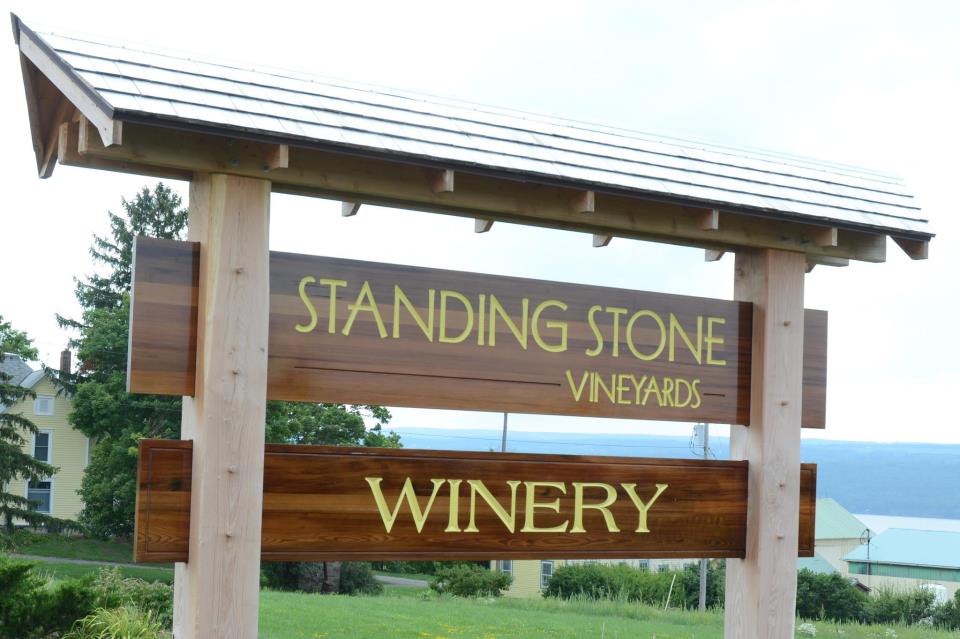
Entrance to Standing Stone Vineyard & Winery

Entrance to Standing Stone Vineyard & Winery