Cool Climate Grapes

     When I was in Monongahela, Pa recently I visited my friends at the Ripepi Winery & Vineyard. I couldn’t have picked a better time to visit because Rich Ripepi and Pete Abvulovic had just unpacked their new Hanna Total Acid and Ph machine for the lab and were setting it up. Rich said the vineyard had come though the winter in great shape. Today turned grape book1out to be my lucky day because Rich had a book he thought I would enjoy reading. Grapes of the Hudson Valley and Other Cool Climate Regions of the United States and Canada by J. Stephen Casscles. It is a comprehensive work covering every aspect of propagating cool climate wine grapes in the northern U.S. and Canada.

He approaches the subject from an expert’s point of view drawing upon his lifetime of experience in the Hudson Valley of New York. This publication can be viewed as the most in-depth account of the history of  hybridization of cool climate grapevines ever published. Casscles has cataloged the genetic heritage of an amazing number of hybridized grapes by the person or organization that developed them. I think you will be surprised to learn where the genetic material of your favorite grapes came from and why they exhibit the characteristics they do. You may also be disappointed to find out that there is no such thing as a pure strain of grape. The truth is they all have genes from other strains in their genetic profile. To prove this fact Casscles uses the example of the “pure” Chardonnay grape. Chardonnay is a combination of a Pinot

Title Page Signed by J. Stephen Casseles

Title Page Signed by J. Stephen Casscles

Noir clone and the bulk white wine/table grape Gouais Blanc.

This book is a must read for anyone growing or wanting to grow wine grapes in a cool climate region of North America. It provides the reader with an immense amount of information and has references to almost any information resource you may need. If you are looking for a handbook/field guide/reference publication for cool climate grapes this is the book for you.

Published by:  Flint Mine Press     http://www.flintminepress.com                      


From The Beginning

     I have been told great wine is made in the vineyard. I believe this to be true because no matter how good a winemaker is there is only so much they can do in the winery to improve a wine made from average grapes. There are a myriad of factors effecting grape quality in a vineyard but it all starts with the vine. Virtually all wine grapes in the U.S., with the exception of those grown in Washington state, are grown on grafted vines. Grafted vines have Phylloxera resistant rootstock with scions of a varietal wine grape grafted to it. Phylloxera is a tiny aphid-like insect that feeds on the roots of the Vitis vinifera grape.

In the not-so-distant past the world’s wine vineyards were devastated by this pest but it isn’t the only threat to the vines. There is a long list of disease, fungus, mold and pests of all shapes and sizes that can damage a vineyard. Dagger and Rootknot are caused by Nematodes (microscopic worms) and are a common problem in the eastern U.S. but their threat can be lessened by choosing the correct rootstock for your situation. Because there are so many factors to consider when choosing a vine for your site it is important to evaluate the characteristic of each rootstock to match it to the needs of your vineyard. The 3309c rootstock is the most widely used rootstock in the eastern U.S. and it can be said that eastern viticulture is built on it.

     In Washington they grow grapes on own rooted vines that makes them susceptible to Phylloxera, although Phylloxera has never been reported there.  The advantage of own rooted vines is that if they are damaged they can regrow from the roots while if a grafted vine is damaged below the graft it has to be replaced or regrafted. A study comparing grapes grown on own rooted vs. grafted vines showed for all practical purposes there was no difference in the quality of fruit produced.

     The Grafted Grapevine Nursery in Clifton Springs, NY was started in 1957 by Herman and Ute Amberg while Herman was working for Dr. N. Shaulis at Cornell University’s Geneva Experimental Station. They specialize primary in one year old bench-grafts but a few varieties are available as own rooted. While looking for Saperavi vines I had the pleasure to correspond with Herman and Ute’s son and Operations Manager Eric. The following is an excerpt from an email Eric sent me in response to my questions about the availability of grafted Saperavi vines and his opinion on a planting density plan for Saperavi.

     “We will be propagating extra Saperavi this year to compensate for its sudden surge in interest. Regarding the planting density for Saperavi. The number of vines is a factor of row spacing and vine density within the row. Row spacing is based more on your equipment than the vine’s need. The standard spacing in most of the eastern half of the country is 9 feet. Density within the row is based more on the vines vigor and training system. We have found that a 7 foot spacing works well. Therefore 691 vines/acre would be appropriate.”

     We sometimes forget just how much thought, effort, cash investment and yes, good luck goes into a great bottle of wine.  Contact info:  graftedgrapevines.com 

Grapevine Pricing Charting: Courtesy of Grafted Grapevine Nursery

Grapevine Pricing Charting: Courtesy of Grafted Grapevine Nursery

China Star Rising

Chateau Changyu, Beiyujia Vineyards, Shandong, China

Chateau Changyu, Beiyujia Vineyards, Shandong, China

I read an article recently about how China has now surpassed France for the amount of land dedicated to wine-making vineyards. China now boasts 1.9 million acres of vineyards, passing France for second place and behind the number one grower, Spain. China remains the 7th largest producer of grapes due to production inefficiencies. The increase in vineyards is in direct response to the need for more wine grapes to satisfy the explosive rise in demand for wine in China. China has experienced a cultural evolution toward drinking wine over the past 15 years that is directly tied to the increase in disposable income. Red wine is preferred by the majority of Chinese wine drinkers so it is no surprise that Cabernet Sauvignon is the most planted grape variety in the country.

China is a huge country with many sub-climates and even more micro-climates, not to mention the countless soil types and varying terrain. I believe when you have that many variables combined with an ancient culture that thrives on challenges and ingenuity the only logical outcome from Chinese wine makers will be superior and creative wines. The wine business in China will continue to focus on products and production to satisfy domestic demand. But as we have seen the Chinese do in so many other arenas, they will be constantly comparing their wine to the best in the world to judge their progress and making changes to excel.

2nd Annual “State of the Vineyard” Address


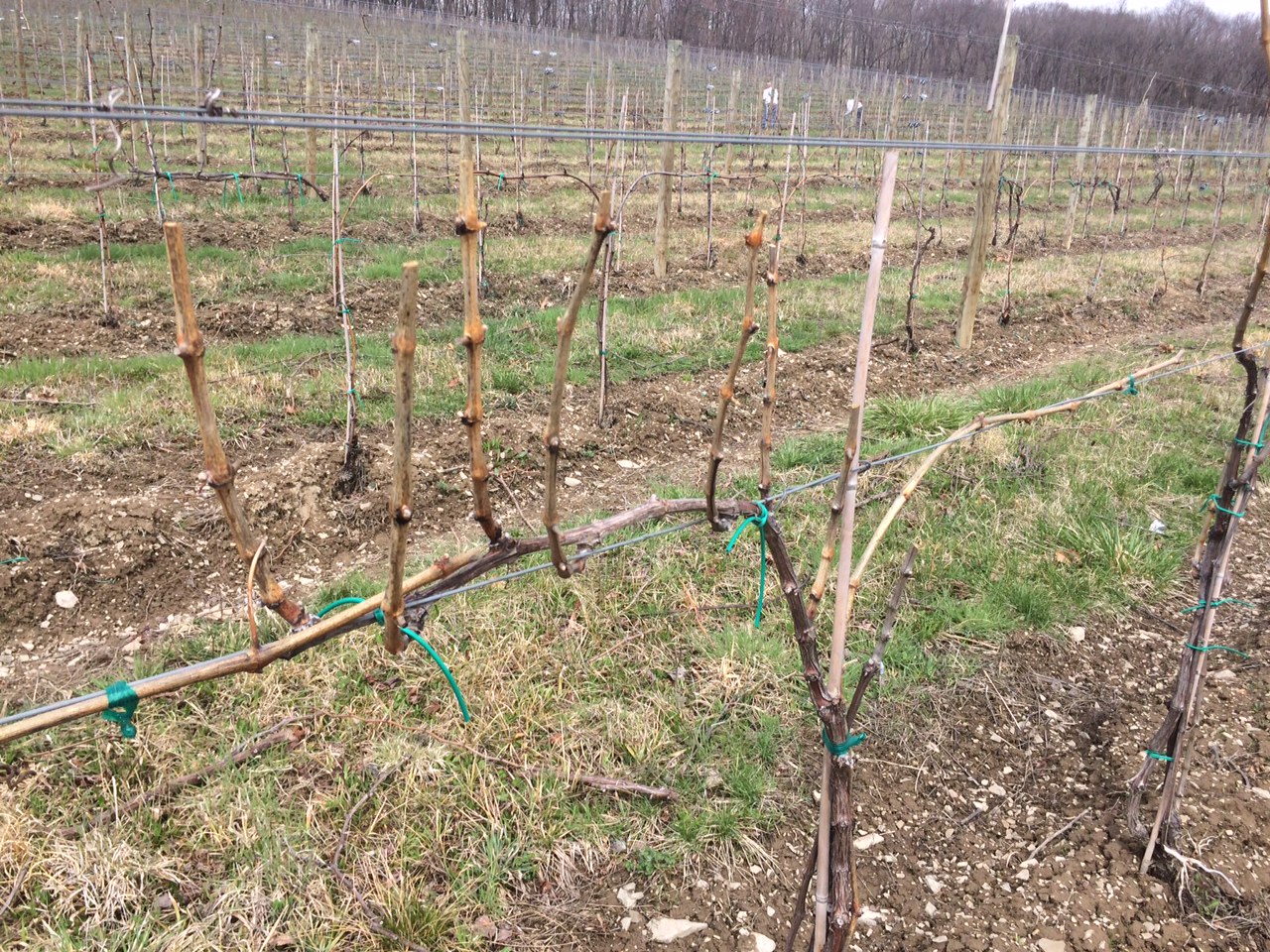
Spur and Kane pruning on same vine @ Briar Valley Vineyards

Spur and Kane pruning on same vine @ Briar Valley Vineyards

     Welcome to the 2nd Annual ” State of the Vineyard” address. the purpose of this post is to give everyone a first look at the 2015 growing season as seen through the eyes of the people who know it best, the growers and wine makers of Western and Central Pennsylvania. After a winter that broke records for cold and snow I found unexpected good news on all fronts. But don’t take it from me read what the experts had to say.

We will start in Central Pennsylvania with Paul Vezzetti winemaker at The Vineyard at Hershey. Paul tells me that their vineyards made it through the winter relatively unscathed by the sub-zero temperatures, even the normally cold sensitive Chardonnay and Riesling showed little damage and with pruning complete he is looking forward to a really big year. A year that will see a new block of vines added to the vineyard that will consist mostly of Muscat but also some Sauvignon Blanc.

      Staying in Central Pa. our next stop is Lewisburg and Chuck Zaleski’s Fero Vineyards & Winery. Chuck grows only vinifera vines and over the last two winters his vine injury has been limited to only a “couple percent”. He feels fortunate to have his vineyard in the Middle Susquehana Valley on a small hilltop in a wide river valley at 41ºN latitude and 600 feet above sea level. He attributes his site for his excellent survival rate that his vineyard has experienced over the years. I want to congratulate Chuck on winning a Double Gold medal at the Finger Lakes International Wine Competition (FLIWC) with his 2013 Estate Lemberger and a Gold with his 2013 Saperavi also at FLIWC.

We now move west into Washington County the home of Ripepi Vineyards & Winery. Rich Ripepi is pleased with how his vines came through this winter. He lost some of his Cabernet Sauvignon vines last winter but the ones that survived made it through this winter in fine shape. The bud count is very good and is a product of an extremely strong growing season in 2014. The only negative Rich could report was a little damage to his 28-year-old Chancellor vines but he couldn’t put his finger on the exact cause. With all the primary trimming complete and half of the secondary done Rich could only express the highest hopes for this coming growing season.

I can never go to Bedford County without stopping to see Tod & Jean Manspeaker at Briar Valley Vineyards & Winery. Tod tells me that this winter was better than the winter of 2014 for their vineyard. The 2014 winter had two freeze events with the second damaging some vines by splitting their trunks and causing “Crown Gall” which will eventually destroy a vine once it’s infected. But this year was different, most of Briar Valley’s vines came through in good shape with the only exception being their Merlot. They had thought they lost 100% of the Merlot vines and had order new vines only to discover that a third of the vines had survived. Tod commented on how differently each variety of his vinifera grapes vines adapted to the environmental factors even though they were all on the same site. The Manspeakers are very busy now with about 1 to 1 1/2 weeks more of pruning to do on their 10 acre vineyard. They do all the pruning themselves to insure that the fruit meets their very high standards. The job this year was made even more difficult by the fact that all the extra canes left on last year had to be removed to prepare the vines for this years growing season. I am happy to report that Briar Valley Vineyards & Winery won two Silver medals at the Finger Lakes International Wine competition (FLIWC) with their 2010 Proprietor’s Red and 2012 Lemberger. 

Our next stop is Greene County to visit Rick Thistlewaite at Thistlewaite Vineyards in Jefferson. Rick told me his vines had a “little more die back” this year but overall damage was minor with it limited to one or two vines per acre. The bud count at Thistlewaite is reported to be good. A two tier pruning protocol is employed where the first pruning leaves a long cane to develop buds that is then cut back with a second pruning after the first frost to give protection against late frost bud damage. When I asked Rick if he thought the site was a contributing factor in this year’s losses, he said that he didn’t think it was because his five acre vineyard is on a hilltop and is planted with all French hybrid vines. His opinion was that this past winter was wetter than last year and he had less snow cover to protect his vines. Thistlewaite Vineyards are planted with nine different varieties of wine grapes with the majority of the vineyard composed of Chambourcin and Traminette. Rick is anticipating another above average harvest this year.

For our last stop in Pennsylvania we will travel to the heart of the Laurel Highlands and make a visit to Christian W. Klay Winery in Chalk Hill. I had the pleasure of meeting Sharon Klay recently and had the opportunity to hear for myself how the winter effected her vineyard. Sharon said this winter wasn’t nearly as destructive to her vines as the last winter was. I could hear the lingering lament in her voice as she recalled losing two acres of her oldest Chardonnay last year but she quickly brightened when she reported the lack of damage this year and the promise of another banner year that lay ahead. I laughed as she told me the resident flock of wild turkeys at the vineyard had discriminating palates for which grapes they ate while leaving others varieties relatively untouched. On the day we talked her son, Christian had just received government approval for his distillery. After becoming fully operational it will offer a synergy with the winery by not only producing its own distilled spirits but using C.W.Klay wine to make grappa, brandy and other distilled products.

     No report would be complete without checking in with our friends in the Finger Lakes Wine Region. Martha “Marti” Macinski reports the vines at Standing Stone Vineyards & Winery Hector, NY do not seem to have suffered damage from this winter. She said the current bud count numbers are showing minimal damage, so minimal that “We did some samples twice”. Last year the samples also showed minimal damage and the crop was of normal quantity with overall quality outstanding. Riesling and Gewürztraminer continues to be strong varieties for Standing Stone with positive growth in the New York Metro area due to the efforts of distributor Fredrick Wildman. When visiting FLX a stop at Standing Stone Vineyards & Winery is a must for any wine lover.

Thank You to everyone that helped me with this post. I wish all the vineyards and wineries the best of luck in 2015 and I hope to see you soon.    Rich


Fero Vineyards & Winery: Saperavi 2013

Fero Vineyards &Winery Saperavi 2013

Fero Vineyards &Winery Saperavi 2013

     I had the pleasure of drinking my first Pennsylvania grown and made Saperavi recently.  It strengthened my belief that the Saperavi grape has the potential to be developed into the signature red grape grown in the cool climate of the Eastern United States.  Fero Vineyards & Winery 2013 Saperavi starts by revealing its beautiful dark purple color, a trademark of this wine.  After admiring the deep color, aromas of red fruit with a hint of oak fills your nose.  Saperavi grapes are known for producing a full-bodied wine with good structure, Fero Saperavi 2013 fulfills those expectations on both counts with style and accuracy.  This East Coast Red has good acidity which complements a subtle note of oak that is carried well into a long finish.  I recommend buying three bottles of this vintage, drink one now and cellar the other two.  Open those bottles after aging them two years and five years, compare your tasting notes,  I am sure you will be impressed by how well this wine will develop over time. 

     Thanks to Chuck Zaleski the owner and winemaker of Fero Winery for pursuing a progressive strategy that is not only designed to grow his business but the quality of wine produced in Pennsylvania.  Fero Vineyards & Winery 965 Jpm Rd Lewisburg, Pa. www.ferovineyards.com   570-568-0846   Fero Saperavi 2013 will be judged at the Pa Farm Show this weekend  1/9/15  Update: Fero Saperavi 2013 has won a Gold medal at the 2015 Finger Lakes International Wine Competition (FLIWC).