Free: New Wine Spectator App

     Wine Spectator has released a new app for iPhones and iPads, but wait it gets better because it is FREE. The app is named Xvalues and claims that the user will “Never buy bad wine again.” “Period.” Xvalues is the latest release from WS and is built on the simple idea that most people are looking for a good wine at a good price when shopping for wine. This app helps the shopper find a good wine at a value price. You can search four topics to find the bottle that best suits your tastes. The four search perimeters are  1) Top Values $12 dollars & under rated 85+    2) Reds $20 & under rated 87+   3) Whites $20 & under rated 87+   4) Sparklers $40 & under rated 85+.

     This app has the potential to be very helpful because it uses Wine Spectator’s rating system to pair the consumer with well-priced readily available wines. Ultimately, the final decision will be based on the buyers preferences but this will assist them in the process of narrowing the field of choices.

     Go to http://apps.winespectator.com or search Xvalues in the Apple App store to get your free app.     

Cool Climate Grapes

     When I was in Monongahela, Pa recently I visited my friends at the Ripepi Winery & Vineyard. I couldn’t have picked a better time to visit because Rich Ripepi and Pete Abvulovic had just unpacked their new Hanna Total Acid and Ph machine for the lab and were setting it up. Rich said the vineyard had come though the winter in great shape. Today turned grape book1out to be my lucky day because Rich had a book he thought I would enjoy reading. Grapes of the Hudson Valley and Other Cool Climate Regions of the United States and Canada by J. Stephen Casscles. It is a comprehensive work covering every aspect of propagating cool climate wine grapes in the northern U.S. and Canada.

He approaches the subject from an expert’s point of view drawing upon his lifetime of experience in the Hudson Valley of New York. This publication can be viewed as the most in-depth account of the history of  hybridization of cool climate grapevines ever published. Casscles has cataloged the genetic heritage of an amazing number of hybridized grapes by the person or organization that developed them. I think you will be surprised to learn where the genetic material of your favorite grapes came from and why they exhibit the characteristics they do. You may also be disappointed to find out that there is no such thing as a pure strain of grape. The truth is they all have genes from other strains in their genetic profile. To prove this fact Casscles uses the example of the “pure” Chardonnay grape. Chardonnay is a combination of a Pinot

Title Page Signed by J. Stephen Casseles

Title Page Signed by J. Stephen Casscles

Noir clone and the bulk white wine/table grape Gouais Blanc.

This book is a must read for anyone growing or wanting to grow wine grapes in a cool climate region of North America. It provides the reader with an immense amount of information and has references to almost any information resource you may need. If you are looking for a handbook/field guide/reference publication for cool climate grapes this is the book for you.

Published by:  Flint Mine Press     http://www.flintminepress.com                      


Golden B&W Memories

Eugenia Frank

Eugenia Frank

Dr. Konstantin Frank Wine Cellars, Hammondsport NY, is releasing it’s new line of single vineyard wines named in honor of three of the most prominent Frank women and the contributions that they have made to the Frank winemaking legacy. These highly anticipated releases celebrate Eugenia (wife of Dr. Konstantin Frank), Hilda (daughter of Dr. Konstantin Frank) and Margrit (wife of Willy Frank).

     “Eugenia” was released in December 2015 and is a Single Vineyard Riesling made from the oldest block of Riesling grown on the winery’s Keuka Lake estate. It was from these steep slopes and shale-rich acidic soil that Dr. Konstantin Frank produced his first Finger Lakes Riesling many years ago. The winery tasting notes describe this Riesling as “Bone dry, with brilliant acidity, elegant minerality and notes of Key lime, stone fruits, pineapple and lime zest.” Cellar through 2024.

     On January 9th, 2016 Dr. Frank Wine Cellars released the second wine in the “Frank Women’s Series”. “Margrit” is a 2014 Riesling made from Dr. Frank’s Hector, NY vineyards. This vineyard is also on a steep slope and is known for being one of the warmest in the FLX. The property has a loamy soil profile that produces a ripe, fruit forward wine. The tasting notes say this Riesling has flavors that are “Tart, tangerine, Granny Smith apple and grassy with a balanced acidity.” Due to limited production these wines will only be available for purchase in their tasting room.

     I think these great photos transcend time and place to express a certain elegance and class that is hard to find in present day society. All photos courtesy of Dr. Frank Wine Cellars. A special thank you to Erin Flynn at Dr. Frank’s for her excellent articles about the Frank women that were the source for this article.

DrFrankwines.com          Twitter: @DrFrankwine

Margrit Frank

Margrit Frank

Book Review: Tangled Vines

Photo Courtesy: St Martin's Press

Photo Courtesy: St Martin’s Press

     When I saw Tangled Vines: Greed, Murder, Obsession and an Arsonist in the Vineyards of California by Frances Dinkelspiel in my stocking on Christmas morning I could hardly wait to begin reading this novel. But when I started to read it I immediately realized that it was the true story of the Wines Central Warehouse fire that had all the elements of the title being methodically recounted in detail by author Frances Dinkelspiel, who herself has a family connection to the tragedy. She lifts the veil of the California industry to let her readers see just how entangled the lives of the people at the center of this empire really are.

     You will recognize many of the names in the book and you may be surprised by how they are portrayed. I would Google many of the events mentioned in the book to read the news accounts of them and get a feel for the accuracy of her reporting. She is very accurate! The California wine community pulled itself through this senseless tragedy by banding together and moving forward.

I would recommend Tangled Vines By France Dinkelspiel to anyone who enjoys reading about real-life drama set in a iconic environment. This had to be a true story because you can’t make this kind of stuff up.

From The Beginning

     I have been told great wine is made in the vineyard. I believe this to be true because no matter how good a winemaker is there is only so much they can do in the winery to improve a wine made from average grapes. There are a myriad of factors effecting grape quality in a vineyard but it all starts with the vine. Virtually all wine grapes in the U.S., with the exception of those grown in Washington state, are grown on grafted vines. Grafted vines have Phylloxera resistant rootstock with scions of a varietal wine grape grafted to it. Phylloxera is a tiny aphid-like insect that feeds on the roots of the Vitis vinifera grape.

In the not-so-distant past the world’s wine vineyards were devastated by this pest but it isn’t the only threat to the vines. There is a long list of disease, fungus, mold and pests of all shapes and sizes that can damage a vineyard. Dagger and Rootknot are caused by Nematodes (microscopic worms) and are a common problem in the eastern U.S. but their threat can be lessened by choosing the correct rootstock for your situation. Because there are so many factors to consider when choosing a vine for your site it is important to evaluate the characteristic of each rootstock to match it to the needs of your vineyard. The 3309c rootstock is the most widely used rootstock in the eastern U.S. and it can be said that eastern viticulture is built on it.

     In Washington they grow grapes on own rooted vines that makes them susceptible to Phylloxera, although Phylloxera has never been reported there.  The advantage of own rooted vines is that if they are damaged they can regrow from the roots while if a grafted vine is damaged below the graft it has to be replaced or regrafted. A study comparing grapes grown on own rooted vs. grafted vines showed for all practical purposes there was no difference in the quality of fruit produced.

     The Grafted Grapevine Nursery in Clifton Springs, NY was started in 1957 by Herman and Ute Amberg while Herman was working for Dr. N. Shaulis at Cornell University’s Geneva Experimental Station. They specialize primary in one year old bench-grafts but a few varieties are available as own rooted. While looking for Saperavi vines I had the pleasure to correspond with Herman and Ute’s son and Operations Manager Eric. The following is an excerpt from an email Eric sent me in response to my questions about the availability of grafted Saperavi vines and his opinion on a planting density plan for Saperavi.

     “We will be propagating extra Saperavi this year to compensate for its sudden surge in interest. Regarding the planting density for Saperavi. The number of vines is a factor of row spacing and vine density within the row. Row spacing is based more on your equipment than the vine’s need. The standard spacing in most of the eastern half of the country is 9 feet. Density within the row is based more on the vines vigor and training system. We have found that a 7 foot spacing works well. Therefore 691 vines/acre would be appropriate.”

     We sometimes forget just how much thought, effort, cash investment and yes, good luck goes into a great bottle of wine.  Contact info:  graftedgrapevines.com 

Grapevine Pricing Charting: Courtesy of Grafted Grapevine Nursery

Grapevine Pricing Charting: Courtesy of Grafted Grapevine Nursery

Standing Stone Barrel Bonanza

Photo Courtesy: Standing Stone Winery

Photo Courtesy: Standing Stone Winery

     This is the perfect event for any wine enthusiast that simply can’t get enough. What is Barrel Bonanza? Barrel Bonanza is an opportunity for you to tour the Barrel Cellar and taste finished and just finished fermented wines every hour on the hour. Learn what type of yeast you like and compare the difference in flavor that new oak verses older oak has on  Chardonnay and Saperavi. Taste the 2014 Reserve Saperavi straight out of the barrel and if you like it you can buy futures at a 20% discount. You can also choose a mini Vertical Tasting of Saperavi, Cabernet Sauvignon or Petit Verdot. If you need to take a break there will be live music and delicious food for you to enjoy.

Barrel Tastings are noon, 1, 2, 3 and 4 – you pick one. Saperavi Vertical is @ 12:30, Cabernet Sauvignon @ 2:30 and the Petit Verdot is @ 3:30. The cost of this event is $20 per person and includes one Vertical Tasting. Extra Vertical Tastings are $10 each.              

Date: Dec. 12, 2015     Time: 12:00 to 5:00   Place: Standing Stone Vineyards 9934 NY-414 Hector, NY.  Call or e-mail for reservations.  607-582-6051   ssvny@standingstonewines.com

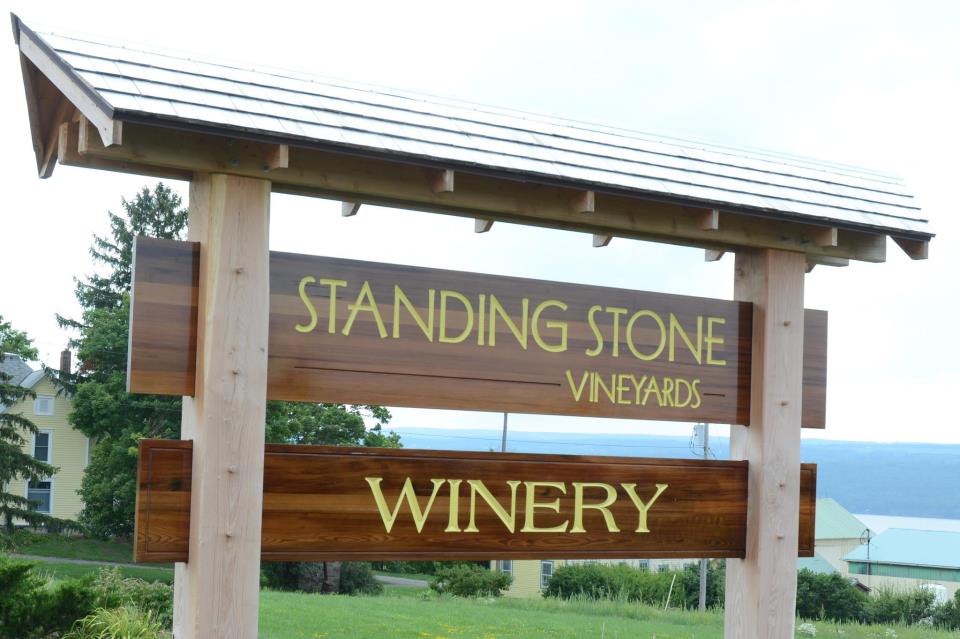
Entrance to Standing Stone Vineyard & Winery

Entrance to Standing Stone Vineyard & Winery

The REAL American Fero

     I just got the good news about this years harvest at Fero Vineyards from Chuck Zaleski, owner/winemaker, Fero Vineyards & Winery Lewisberg,Pa. Instead of me telling you what he said I decided you would get a more personal view into the harvest if you heard it from the man who knows Fero Vineyards better than anyone. The following is an excerpt from an e-mail Chuck sent me.

” We had a great harvest this year. Fruit quality was excellent and the yield remained at historical levels. I think we found the right site for our varieties.

     My Saperavi is leveling out at about 2 ton on 1/2 acre. This gives me about 125 cases of wine. We will be bottling last years vintage this December. I like the way it has matured. We picked earlier that year so the acidity is a little higher. This years harvest is hopefully hitting the peak ripeness for flavor, smoothness and durability. I have been doing some benchmark tastings of domestic and foreign Saperavi. There is a large variation in the level of oak exposure. I am leaning away from the oak. It also is historically not an oak aged variety. The grape has such a nice flavor on its own and this gets overwhelmed by the oak. It also is historically not an oak aged variety. 

I am happy to hear that the harvest at Fero Vineyards was excellent. I have always been told that great wine is made in the vineyard and after hearing that the harvest was record-setting in both quality and quantity at every vineyard I talked with I have the highest expectations for the 2015 vintage. Thanks to Chuck for taking the time and effort to keep me and my readers updated with events at his winery and in his vineyard.

Fero Wines with Medals won at 2015 Finger Lakes International Wine Competition.

Fero Wines with Medals won at 2015 Finger Lakes International Wine Competition.


Fero Wines display Medals won at 2015 Pa Farm Show.

Fero Wines display Medals won at 2015 Pa Farm Show.

Social Media Does a Winery Good

Source: Social Media Does a Winery Good   This article was posted by Kat Collins on her blog HumbleWineSnob. Kat is a manager at Blue Mountain Vineyards. This post is a good starting point for anyone considering a social media strategy plus it has ideas on continuing the development of an existing program.

Ripepi Diamond is Forever


Diamond Grapes Photo Courtesy: Cornell University

Diamond Grapes Photo Courtesy: Cornell University

  The white grape Diamond is a cross between the Concord and Iona (Vitis Vinifera –labrusca hybrid) grape developed in Western New York during the mid 1880’s. This grape had a major influence on winemaking in the Eastern U.S. during most of the 20th century. The high sugar content of this grape also makes it a desirable table grape as well as an excellent source of grape juice. Despite being one of the few white American grapes varieties used to produce dry wine the recent plantings of Diamond have declined with the trend toward European varietals. Although Diamond can be found in many AVA’s in the U.S. and around the world it is most prominent in New York and Pennsylvania.

Diamond 1  Rich Ripepi at Ripepi Winery in Monongahela, Pa has taken this traditional American grape and updated it to suit the taste of today’s wine drinkers. Ripepi Diamond is a dry wine but not so dry that the fruity taste of the Diamond grape is lost in translation. It’s body comes across as being lighter and crisper because of it’s lower residual sugar, making it a wine that is easy to drink. Stylish and balanced are the two words I would use to describe Ripepi Diamond. I have tasted plenty of Diamond, most are too sweet, one even had a large red-hot pepper in the bottle, but I can honestly say that Ripepi Dry Diamond was the best Diamond that I have tasted. I think that if the Diamond grape is going to experience a revival it will have to be made in a non-traditional style. Rich Ripepi has told me many times that when it comes to winemaking “It’s all about the style.”

2015 Seven Springs Wine Festival

Wine

     The 2015 Seven Springs Wine Festival will be held August 28th through the 30th at the Seven Springs Mountain Resort Champion, Pa. With paid admission you can enjoy complimentary tastings from 31 Pennsylvania wineries with your free souvenir wine glass along with wine-themed seminars, live musical entertainment and other interesting attractions. A 5 p.m. – 9 p.m. Friday night session has been added this year in addition to the regular 11 a.m. – 5 p.m. hours on Saturday and Sunday. More information and the option to buy tickets can be found at the Seven Springs Resort website. www.7springs.com/events/wine-festival/