 May the spirit of hope that Easter brings, fill your life with love and joy.
Tag wine

West Pa. Winery & Brewery Website
 West Pa. Winery & Brewery is the companion website to this blog. I started this site as a comprehensive source of contact information for many of the wineries and breweries in Western Pennsylvania. The homepage allows you to choose directories for wineries and breweries that list addresses, phone numbers, and links to these businesses. Links to this months and next months scheduled events can be easily accessed by clicking on the desired months tab. You can view photos either on the gallery page or on the scrolling slide show on the homepage. The “More” tab contains pages for contacting me with your event info, a Finger Lakes Region winery directory plus a page linking you to some of my blog posts. I started this website with the sole purpose of providing a place where you could find all the info about the wineries and breweries in West Pa. I don’t have a hit counter on this site and had no idea if it was being used until I was doing maintenance on it and I noticed it had 5000 Facebook “Likes”. There isn’t a Facebook page for this site and I am asking everyone to help me promote it by giving it a “Like”, tweet, retweet, post, repost, well you get the idea. I hope this site can be helpful in educating the public on what is available for them in the area of winery and brewery entertainment. Thank You twitter@wpawinepirate West Pa. Winery & Brewery
Share this:

On the Edge of Glory
 I talked with Chuck Zaleski of Fero Vineyards & Winery in Lewisburg, Pa recently and got the inside story on “What’s New” at his winery. When I asked about the 2014 harvest his voice filled with pride and excitement saying it was a record year in both quality and quantity. The harvest was so good that he even sold some grapes this year. It is a good thing that his vineyards are producing extraordinarily well because Chuck was planning on sales growth of 20% last year but it came in at 30%. This year he will hold growth to 20% because his focus is always on the quality of the wine being maintained and improved. Fero is the only producing Saperavi vineyard in Pennsylvania and Chuck’s plan is to double his acreage of Saperavi grapes as soon as he can acquire the vines.
Fero will be adding three new sweet wines to the menu this year. The apple, cherry and peach wines will be made from the same Grüner Veltliner grapes grown in their vineyard that produced a Double Gold medal winner at the 2015 Pa. Farm Show. Chuck makes great sweet wines but his real passion is for his excellent dry wines. The judges at the 2015 Pa. Farm Show awarded Fero Vineyards & Winery 8 medals, they are: Double Gold: Grüner Veltliner , Gold: Pinot Gris, 3 Silver: Reisling, Pinot Noir and Saperavi and 3 Bronze.
This year’s fund- raising schedule is nearly full with only a very few dates still available. New this year will be the Wine-N-Mile on May 29th. This event is similar to a Beer-N-Mile where runners race a figure 8 course through the vineyard stopping at six stations to drink 2 ounces of wine at each. After the race guests are invited to stay for live music and the summer “Happy Hour” kickoff.
If you would like more information about Fero Vineyards & Winery wine or events visit www.ferovineyards.com or call 570-568-0846
Share this:

Ripepi Winery & Vineyard
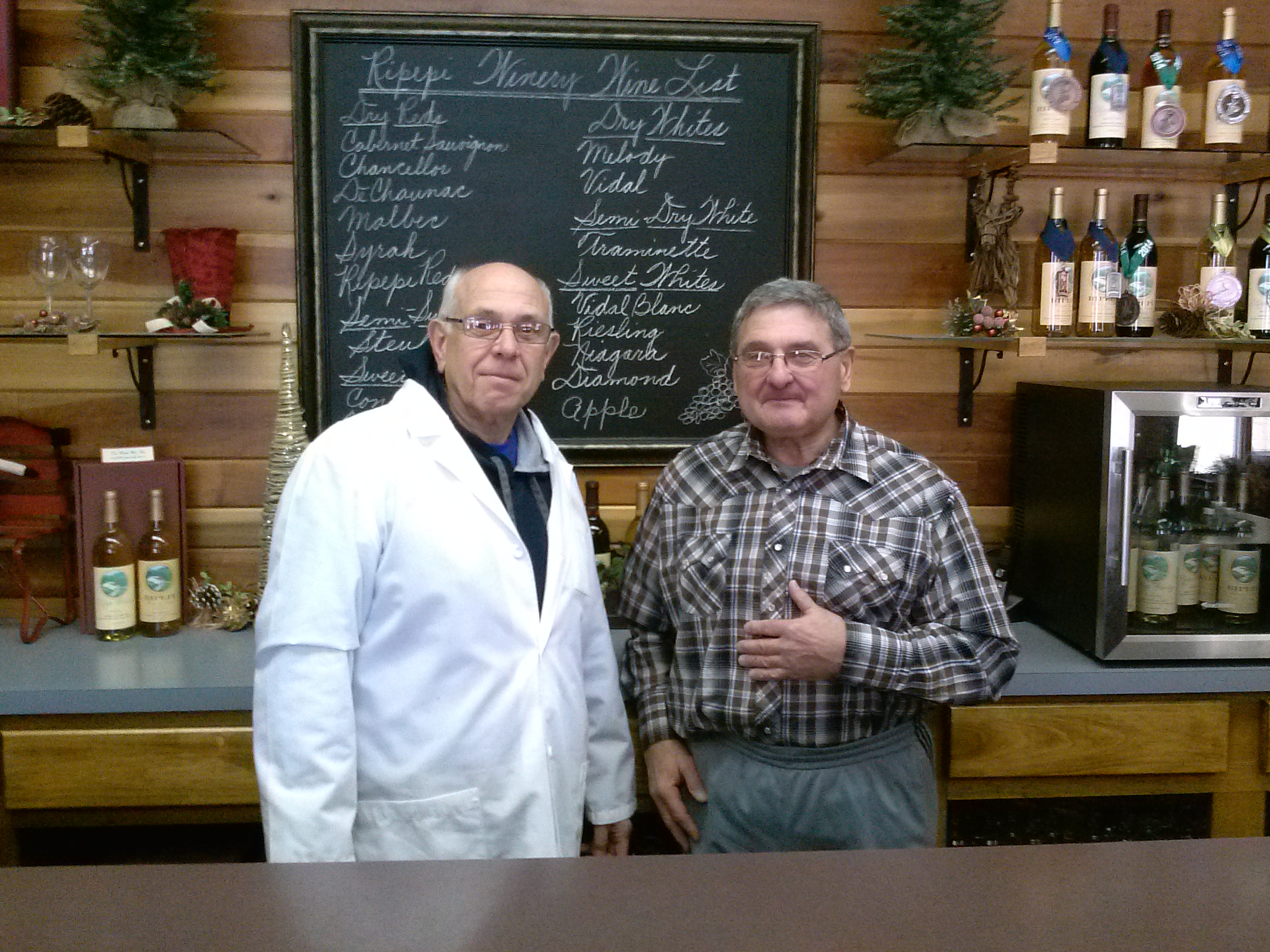
Winery Manager: Pete Abvulovic (L) Owner&Winemaker: Rich Ripepi(R)
When you think of leaders in the resurgence of winemaking in Western Pennsylvania one name that should immediately come to mind is Richard Ripepi and his Ripepi Winery & Vineyard in Monongahela. Rich showed great foresight when he founded his vineyard in 1987. Those initial rows of grapes have now grown into a 10 acre vineyard containing nearly 5000 vines made up of 21 different varieties of wine grapes.
The day I visited Rich I found him to be the same welcoming and gracious host that I have come to know over the years, the kind that always makes you feel like one of the family. While sitting in his tasting room I took the opportunity to ask him how the 2014 season had played out. He told me it started out in early March with him leaving on extra buds because that was the consensus last year due to the extreme winter we had just experienced and the excepted damage it had caused to the vines. In reality his vines sustained little if any damage with the exception being his Cabernet Sauvignon that required some vines to be replaced because of winter damage. The spring brought rain and extra growth that prepared the vines for a huge volume of fruit to be set. After June 10th normally the grapes should on the vines signaling it is time for the nets to go up and the spraying program to end. It rained hard all summer and because of that the spraying had to continue to protect the crop. By late August the vines were so laden with fruit Rich had to decide whether to drop a portion of the fruit or roll the dice on perfect fall weather. Rich went with rolling the dice and he won. September had abundant sunshine and little rain making conditions favorable for all of his grape varieties to ripen within a 3 week picking window instead of the usual 6 week harvest season. Rich was both surprised and delighted with the resulting harvest that was the most bountiful and high quality of any in the history of Ripepi Vineyard. Vines that usually average 7 to 8 pounds of fruit each produced 10 to 12 pounds per plant in 2014.
Work at a winery may slow in the winter but it never stops. During my visit they were moving 800 gallons of wine outside to cold stabilize while Winery Manager Pete Abvulovic was in the lab working to find the alcohol content of various wines. Decisions were being made on which Ripepi wines would be sent to the Finger Lakes International Wine Competition (F.L.I.W.C.) and which would be entered into the Pennsylvania Wine Association (P.W.A.) competition.
Rich honed his wine making skills by attending conferences and workshops sponsored by various universities and wine industry organizations. During the early days of his winery he was helped immensely by two people that he met at these gatherings. Rich made a special point to acknowledge the invaluable help given to him by his friends and viticulture experts, the late Robert Pool of Cornell University and the late Dr. Garth Cahoon of Ohio State University.
No trip to Ripepi Winery & Vineyard would be complete without tasting wine. I tasted his award-winning DeChaunac, an excellent Merlot-like Chancellor and the 2013 Cabernet Sauvignon. The Cab was especially enjoyable because it contained grapes that my wife and I helped pick during the 2013 harvest that was featured in my post ” Harvest at Ripepi Winery “. For more information go to www.ripepiwine.com or follow him on twitter at @RipepiWinery Phone: 724-288-3738
Share this:

Oak
The flavor and aroma of oak in wine is only second to Red or White in dividing wine drinkers. Many people simply will not give themselves a chance to appreciate how oak can be artfully used to enhance wine quality whether it’s Red or White. I like the flavor of oak in any of its applications especially when it is used to shape a wine into a more complex version of itself. Wine makers have leaned on oak barrels for centuries to give their wine both structure and flavors. The oxygen that seeps into the barrels helps mature the wine while causing the loss of a small amount of wine that is said to be the ” Angel
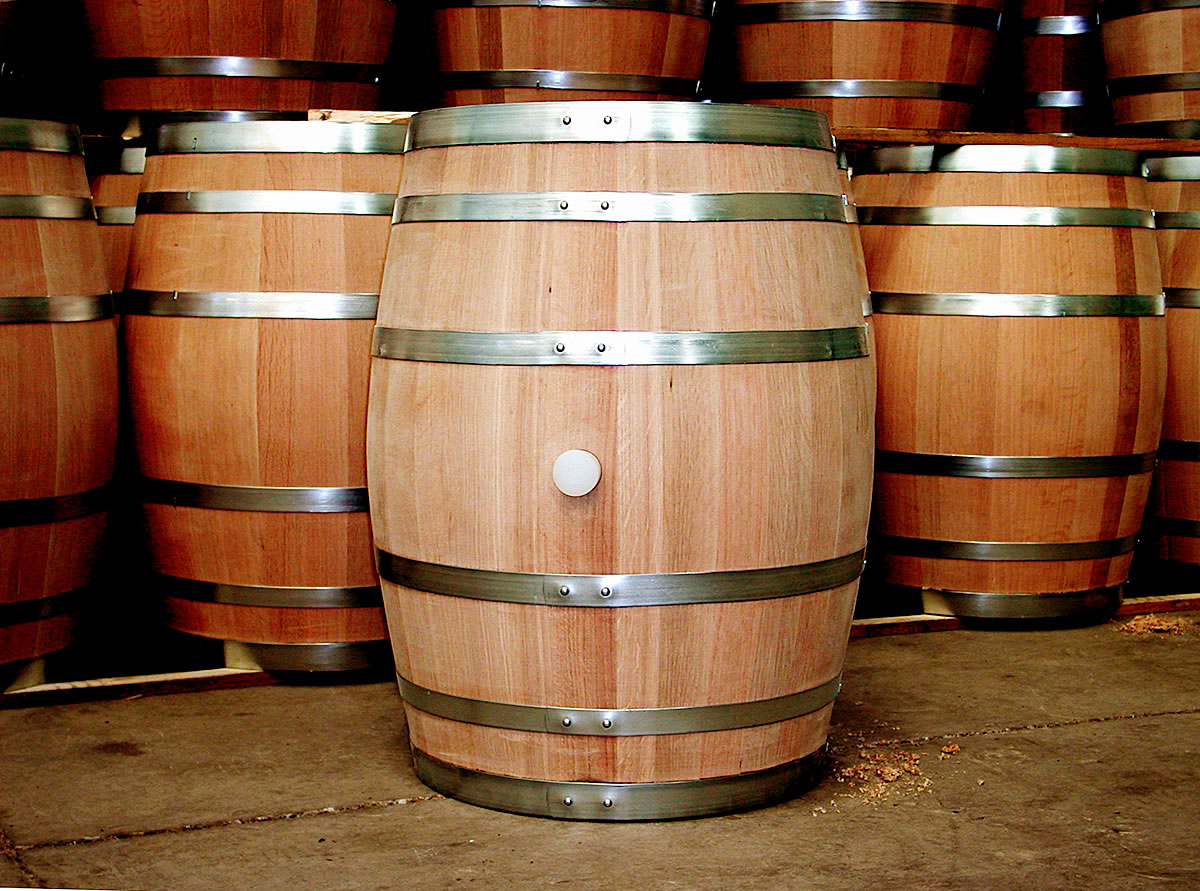
New Oak Wine Barrel
Share”. Oak wood for wine barrels is grown throughout the world and has a distinctive flavor associated with each region from which it is harvested. American Oak has a pronounced level of flavor that is imparted to the wine while French Oak is said to be more subtle (Let the arguments begin). Coopers are able to give wine makers more control over their flavors by the amount of toasting they do to the inside of a barrel, mixing different kinds oak staves used to make a barrel and even making the oak wood in to chips or sticks that can be floated in vats of wine. Today’s wine makers don’t have to paint the portrait of a wine using only broad brush strokes of oak, they can paint shadows of light and dark accents of flavors with the precision of an artist using small brush strokes to bring out all the nuances of a wine. The organic compounds that are released into the wine give it structure and flavor while drawing out hidden flavors to add complexity to the wine. When done correctly the addition of oak can produce a truly unique wine. The difference that oak makes in the personality of a wine can be seen by tasting three different Chardonnay. The first being made entirely in stainless steel to preserve fruit flavors, the second aged in used barrels for texture only and the third aged in new oak to get a creamy texture plus an aromatic vanilla taste. After tasting the differences in the three you will be able to the tell which methods you like the best.
Share this:

Fero Vineyards & Winery: Saperavi 2013

Fero Vineyards &Winery Saperavi 2013
I had the pleasure of drinking my first Pennsylvania grown and made Saperavi recently. It strengthened my belief that the Saperavi grape has the potential to be developed into the signature red grape grown in the cool climate of the Eastern United States. Fero Vineyards & Winery 2013 Saperavi starts by revealing its beautiful dark purple color, a trademark of this wine. After admiring the deep color, aromas of red fruit with a hint of oak fills your nose. Saperavi grapes are known for producing a full-bodied wine with good structure, Fero Saperavi 2013 fulfills those expectations on both counts with style and accuracy. This East Coast Red has good acidity which complements a subtle note of oak that is carried well into a long finish. I recommend buying three bottles of this vintage, drink one now and cellar the other two. Open those bottles after aging them two years and five years, compare your tasting notes, I am sure you will be impressed by how well this wine will develop over time.
Thanks to Chuck Zaleski the owner and winemaker of Fero Winery for pursuing a progressive strategy that is not only designed to grow his business but the quality of wine produced in Pennsylvania. Fero Vineyards & Winery 965 Jpm Rd Lewisburg, Pa. www.ferovineyards.com 570-568-0846 Fero Saperavi 2013 will be judged at the Pa Farm Show this weekend 1/9/15 Update: Fero Saperavi 2013 has won a Gold medal at the 2015 Finger Lakes International Wine Competition (FLIWC).
Share this:


Share this:

Happy New Year!
Merry Christmas
 May all that brings you happiness and gives you joy be yours this holiday season. Merry Christmas to you and your loved ones.
Share this:

Saperavi: The Next Big Thing?

Saperavi Grapes Photo Courtesy Wikipedia
The Red Wines of the East Coast have never gotten the love that their White Wine counterparts have received over the years and in most cases for good reason. But that may change if an old Eastern European grape can live up to its promise of becoming the foundation on which the future of eastern Red Wine is built. The wine grape that I am talking about is Saperavi. This grape variety originated in the Georgian Republic of Russia and features a dark skin with

Chuck & Daneen Zaleski Owners Fero Vineyards & Winery
pink flesh. It is a teinturier variety of grape, meaning unlike most grapes that have uncolored flesh and produce clear juice a teinturier has red-tinted flesh that makes a vibrant richly colored wine. Saperavi vines are grown throughout the area connecting Asia and Europe know as the Caucasus and in various regions of the former Soviet Republic. Sapervai has long been viewed as an ideal ingredient for cheaper blended wines but in recent decades it has been proven to be capable of producing a varietal of high quality. The best Georgian-produced Saperavi comes from the Kakheti Region that is near its eastern border with Azerbaijan. These Georgian-made wines are available in the U.S. but you will have to do some searching to find them. The fact that this grape is late-ripening and thrives in a cooler climate while producing generous yields without sacrificing much in quality is the reason that vintners in the Finger Lakes and Central Pennsylvania are exploring its potential within their vineyards. I have mentioned in earlier posts the pioneering work done by the Standing Stone Vineyards and Winery with Saperavi but I have recently learned of a producing vineyard in Lewisburg, Pa. Chuck and Daneen Zaleski owners of Fero Vineyards and Winery have produced a varietal from Saperavi grapes grown in their Central Pennsylvania vineyard and made exclusively in their Lewisburg winery. Chuck Zaleski at Fero and Marti Macinski at Standing Stone are on the cutting edge of this exciting reinvention of an Old World stalwart. I am excited to have the chance to follow the evolution of the Saperavi wine grape in the Eastern United States from the persceptive of the wine makers themselves. For more information about these two fine wineries visit their websites at: www.standingstonewines.com and www.ferovineyards.com
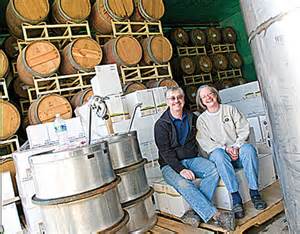
Tom & Marti Macinski Owners Standing Stone Winery Photo Courtsey:Examiner.com
Share this:

There’s a New Kid in Town

James and Rebecca McCeney celebrate Bridges Wine Co.
There’s a new kid in town and that kid is James McCeney. James has established his Bridges Wine Co. in the Point Breeze section of Pittsburgh on the second floor of a former warehouse at 6901 Lynn Way. McCeney married a local girl and settled in Squirrel Hill after leading the life of a wine vagabond. James was thirteen when he started working summers at a winery which eventually lead him to Napa Valley, California where he attended the University of California, Davis studying viticulture and enology. To take part in two harvests a year he split his time between California, New Zealand and Australia but with his wonderlust still not satisfied he managed to find time to work in Burgundy, France. You are probably are wondering how McCeney produces his wine from the second floor of a warehouse in the East End of Pittsburgh. Bridges wine is fermented in Sonoma, California and shipped to Erie, Pennsylvania for bottling then delivered to Pittsburgh. James hopes to someday consolidate his operations entirely here in Pittsburgh. Bridges Wine Co. has two initial offerings, a 2012 Sonoma Coast Pinot Noir and a 2012 Sonoma Valley Zinfandel , both are available online at www.bridgeswineco.com. The 2012 Sonoma Coast Pinot Noir is dark, rich and well-balanced with a nose of raspberries, strawberries and vanilla. The palate of spicy cherry is carried on refined tannins and a lively acidity into a long fleshy finish. 2012 Sonoma Valley Zinfandel is a deep purple wine that delivers with aromas of plum, black cherry and Asian spice that leads into flavors of ripe fruit. The structure is one of firm tannins and focused acidity with a hint of French Oak on the finish.
B.W.C. will soon be offering a Muscato that is now in the fermentation stage and is progressing as planned. James wanted to let everyone know that the tasting hours at his Point Breeze tasting room will be 12 pm – 6 pm Wednesday – Saturday and free shipping will be offered for the holidays.
I am happy to welcome James McCeney and his Bridges Wine Company to the winemaking family of Western Pennsylvania and as it is with any large and boisterous family there is always room for one more at the table.

 wpawinepirate