“New World Saperavi” Report

     I have developed a fascination for the Saperavi grape. This may seem odd even if you have heard of Saperavi wine because it is nothing new to the wine world. The Saperavi that fascinates me isn’t from the Kakheti region of Georgia , Russia but “New World Saperavi” that is being produced here in the Northeastern U. S., namely the Finger Lakes Wine Region of New York and in Central Pennsylvania. Saperavi is a very deeply colored red wine made from the ancient Saperavi grape that originated in one of the oldest wine growing regions of the world. Saperavi grapes are a teinturier grape, meaning its skin and flesh both have pigment which leads to a very delicious dark wine. What follows is the current state of Saperavi in America as told to me by the producers themselves.

Dr. Konstantin Frank Vinifera Wine Cellar

When the Finger Lakes Wine Region is mentioned undoubtably the first name that comes Dr Frank Logoto mind is the iconic Dr. Konstantin Frank Winery in Hammondsport. The legendary Dr. Frank proved everyone wrong not only by growing vinifera grapes in the FLX but producing world-class award-winning wine from them. I would like to thank Frederick Frank for the time and attention he showed me while assisting me with this post. Dr. Konstantin Frank first planted Saperavi vines in his vineyard in 1958. Dr. Frank would use that fruit to produce his first vintage in 1962. Dr. Konstantin Frank Winery now has 1.5 acres planted in Saperavi vines and expects to produce 250 cases of Saperavi wine. That 1.5 acres of Saperavi vines is divided between their Keuka Lake vineyards in Hammondsport and their Seneca Lake vineyards (on the eastern side) in Hector. Dr. Frank’s Saperavi is only available at their winery tasting room in Hammondsport but they are planning to expand their plantings and hope to offer their Saperavi wine to their wholesalers in the future. Due to high demand and limited production they haven’t entered Dr. Frank Saperavi into wine competitions.  drfrankwines.com 

Standing Stone Vineyards

For years Marti Macinski owner/winemaker of Standing Stone Vineyards has extolled the virtues of Saperavi while methodically expanding her Saperavi vineyard and constantly improving her wine. Having appeared in many local, regional and national publications Standing Stone wine sales have ridden a steadily ascending arc but no member of Marti’s Standing Stone Saperavisolid menu of wine appears to have create a devoted following like her Saperavi has.

Standing Stone planted their first 80 vines in 1994 and they are the source of the fruit for their newly released 2013 Reserve Saperavi. Since 2006 a deliberate and steady expansion of the Saperavi program has led to a vineyard that is just over 5 acres. 2005 was a trial run that yielded 23.5 cases. 2010 was Standing Stone’s first commercial release with 200 cases produced that year. This year the 2015 vintage is anticipated to be about 500 cases but Marti adds the caveat ” if we manage to hold off the deer.” Those deer will have more fruit to choose from because Standing Stone continues to plant more Saperavi vines to increase supply and build inventory for market after the winery has enough grapes for their own wine production. That future production may include experimenting with longer aging, some sweeter versions of Saperavi or possibly a Rosé or Port. Standing Stone Saperavi is very round with delicious ripe flavors of tart cherry fruit when young that evolves into plum and pomegranate that are integrated into complex layers of aroma and flavors as it ages. Marti doesn’t enter her Saperavi into many competitions so when she does it comes as no surprise that Standing Stone Saperavi 2012 was awarded the Wine & Food Classic Gold Medal last year and the 2013 Saperavi  won “Best Other Red Vinifera” at this year’s Classic. A special thanks to Marti Macinski for all the time and effort that you have taken to help me with this post and all the other projects you have assisted me on. standingstonewines.com 

Fero Vineyards & Winery

Fero LogoFero Vineyards & Winery is the only winery in Pennsylvania that I am aware of that has Saperavi planted in it’s vineyard. Chuck Zaleski owner/winemaker of Fero planted his first 500 Saperavi vines on 1/2 acre of his Lewisburg, Pennsylvania vineyard in 2010. He conducted trials as his vines matured until he released his first vintage from the 2013 harvest which consisted of 50 cases. The first Saperavi I ever tasted was Chuck’s 2013 Saperavi  from that first 50 cases he produced. After tasting that wine I was sold on the potential of this Georgian red grape here in the East. The 2014 harvest produced 125 cases and the 2015 harvest , expected to be in October, is estimated to yield similar volume. With the addition of 1/2 acre of Saperavi plantings the projected production will be 4-5 tons per acre. The final production number for Saperavi produced should be approximately 300 cases.

Chuck’s philosophy is to let the grape determine the style, so the style of his Saperavi really does remain “Fluid”. He let the 2013 vintage hang and made a ripe jammy style the both of us loved. He picked earlier in 2014 for added acidity and weather concerns plus because of some reading he had done. He said the 2014 may take a little longer to soften but may have more longevity. Chuck doesn’t use much oak at all because he wants to showcase the grape’s unique rich flavor. He tries to mimic traditional methods as much as possible by fermenting in tall containers at constant temperature, very similar to a Qveri and age it with minimal disturbing on the lees. Fero Saperavi 2013 won a Gold Medal at the Finger Lakes International Wine Competition this year. Enough said!

Chuck’s most intriquing observation about this varity is it’s ability to rival the full-bodied red wines of the warm climate regions. He doesn’t know where the ideal location to produce Saperavi in the U.S. is but is pretty sure it isn’t too far from Central Pa. Chuck’s only problem with Saperavi is that it is selling out too fast before he can satisfy demand. Looks like a great problem to have. Thanks to Chuck Zaleski for introducing me to Saperavi and all the help he has given me.  ferovineyards.com

McGregor Vineyard

John McGregor and his McGregor Black Russian Red have always been an enigma in the FLX. In the Spring of 1980 he planted Saperavi, Sereksiya Charni, Rkatsiteli and Sereksiya Rosé in a limited area of his vineyard. From that first planting his Saperavi and Sereksiya Charni has expanded to 4 acres. In 1985 John made a small experimental batch from these grapes and bottled it in half bottles. McGregor Saperavi and Sereksiya are bottled together and produces over 300 cases per year. That number is certain to rise as more Saperavi vines are planted over the next 3-5 years.

If you are wondering what McGregor Black Russian Red Saperavi & Sereksiya blend taste like here is how John McGregor described it to me ” It’s a very rich, dark red wine that typically spends over two years in oak barrels. It has great structure and depth with flavors typically reminiscent of black currents, blackberries and elderberries entwined with a sweet oak character. It has plenty of tannic structure and generally high acidity, lending it well to long-term cellar aging.” 1985 Saperavi (label)

McGregor Saperavi is entered into few , if any, annual competitions but earlier vintages have been awarded Double Gold and Gold Medals. The 2010 vintage received an 87 point rating in the May 2014 issue of Wine Enthusiast magazine. After decades of hard work Black Russian Red has grown into what John calls “The Cult red wine of the Finger Lakes.” No matter what you call it the one thing you can call it is “Successful.” The label to the right appeared on the McGregor 1985 Saperavi bottle. Thanks John McGregor for the invaluable help you gave me with this article.    McGregorwinery.com 

Will Saperavi develop into the signature Red wine of the East? The quality is certainly there and the vines are able to express the terroir of the vineyards in which they are planted to produce a wine on par or better than their Russian counterparts. The demand for Saperavi is increasing to the point where demand is out pacing supply while supply is also increasing but at a slower rate because of many factors. I believe Saperavi will find its place as the top varietal Red wine of the East but it will take time simply because there are so many obstacles to overcome and that things move slowly for new wine grape development in any region of the world. If you can’t find Saperavi from one of the producers mentioned in this post I recommend that you try a Saperavi from any of the regions where it’s made. Help me tell the secret of Saperavi  wine to wine lovers everywhere. Please repost this article. 


FLX: Epilogue

Vineyards above Keuka Lake.

Vineyards above Keuka Lake.

     My latest trip to the FLX was enjoyable, informative, surprising, relaxing and like always too short. I learned many things from the people I met and the events I observed. Here are a few things that I learned by mingling with the locals. The latest fad in the vineyards is to plant Grüner Veltliner. The east side of Seneca Lake felt cooler in summer than the west because the wind blew across the cold waters of the lake. Marti Macinski, Standing Stone’s owner/winemaker was a lawyer before she followed her dream of becoming a winemaker. Saperavi is in demand and is selling out around the lakes, even at premium prices. Wine tourism is on the rise and wineries are competing more aggressively to attract customers. I just can’t get used to mini marts with craft beer taps and growlers at the cash register.

In the FLX there are some things that never change. Some of the best Riesling in the world can be found at great prices. Scenic views of beautiful glacial lakes surrounded by vineyards that you can’t find anywhere else in this country. Welcoming and hospitable people that are happy to see you and strive to put the region’s best foot forward to visitors.

It’s not Sonoma and it’s not Napa, it’s the Finger Lakes Region of New York, a truly unique place. My suggestion to you would be not to take my word for it but to go see it for yourself.

Highlight of FLX Visit

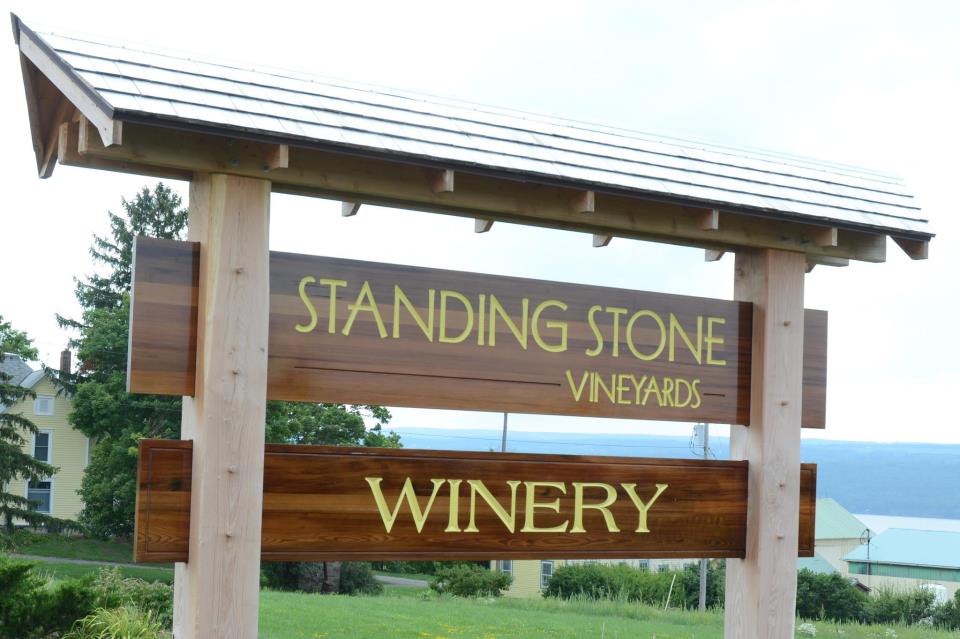
Entrance to Standing Stone Vineyard & Winery

Entrance to Standing Stone Vineyards & Winery

     On every trip there is one experience that stamps its indelible mark on your memory. On this trip it was meeting Marti Macinski and the time we spent at her Standing Stone Vineyards & Winery. Upon our arrival she greeted us with a genuinely heart-felt welcome. Marti was accompanied by her personable and outgoing intern Griffin Lehman. She lead my wife and I through a tasting of all of her excellent wines. I was very impressed by how good all the wines were. If I were to use one word to describe all of the Standing Stone wines we tasted that day it would be balanced. Balance is very important to me when I taste wine because it allows me to taste all aspects of the wine without having certain overdone or underdeveloped characteristics create a biased wine. When you drink a wine made by Marti Macinski you can taste every nuance of the wine and the terroir of her vineyards.

     Her Riesling were some of the best that I tasted in the FLX and I tasted the best Riesling that I have ever tasted there on this visit. I really liked her Saperavi and it confirmed my opinion that this grape has great potential in the Eastern U.S.. She convinced us to try her Ice wine even though we were never fans of Ice wine. We are glad we did because we loved all four of her offerings : Chardonnay, Vidal, Grwürztraminer and Riesling. The entire menu of wines offered by Standing Stone Winery are well crafted and certainly worth your attention when you visit. I can highly recommend a visit to this Seneca Lake winery in Hector N.Y. for anyone attending the 2015 Wine Bloggers Conference or someone visiting the area looking for superior wine.  Standingstonewines.com  607-582-6051   9934 Rte 414  Hector, N Y 14841

View of Seneca Lake & Vineyards from Standing Stone

View of Seneca Lake & Vineyards from Standing Stone

New York State of Mind

sign     The Finger Lakes Wine Region of New York (FLX) is only a 5 hour drive from my home in Southwestern Pennsylvania. Having a World-Class wine-producing region so close provides my wife and me the luxury of making a trip to the area when the mood strikes us. During our trip last week we visited old favorites Herman J. Herman Winery and Dr. Konstantin Frank Winery while adding a new favorite Standing Stone Winery. All three of these wineries produce excellent Riesling along with other notable wines. Cool-climate white wines have always been this region’s claim to fame but on this visit I was curious to see first-hand how the development of the Saperavi grape was progressing. In the following series of posts I will give you my personal take on the wine, grapevines, trends and scenic views I encountered around these glacial lakes. Come along with me and see what’s new in the FLX.

2nd Annual “State of the Vineyard” Address


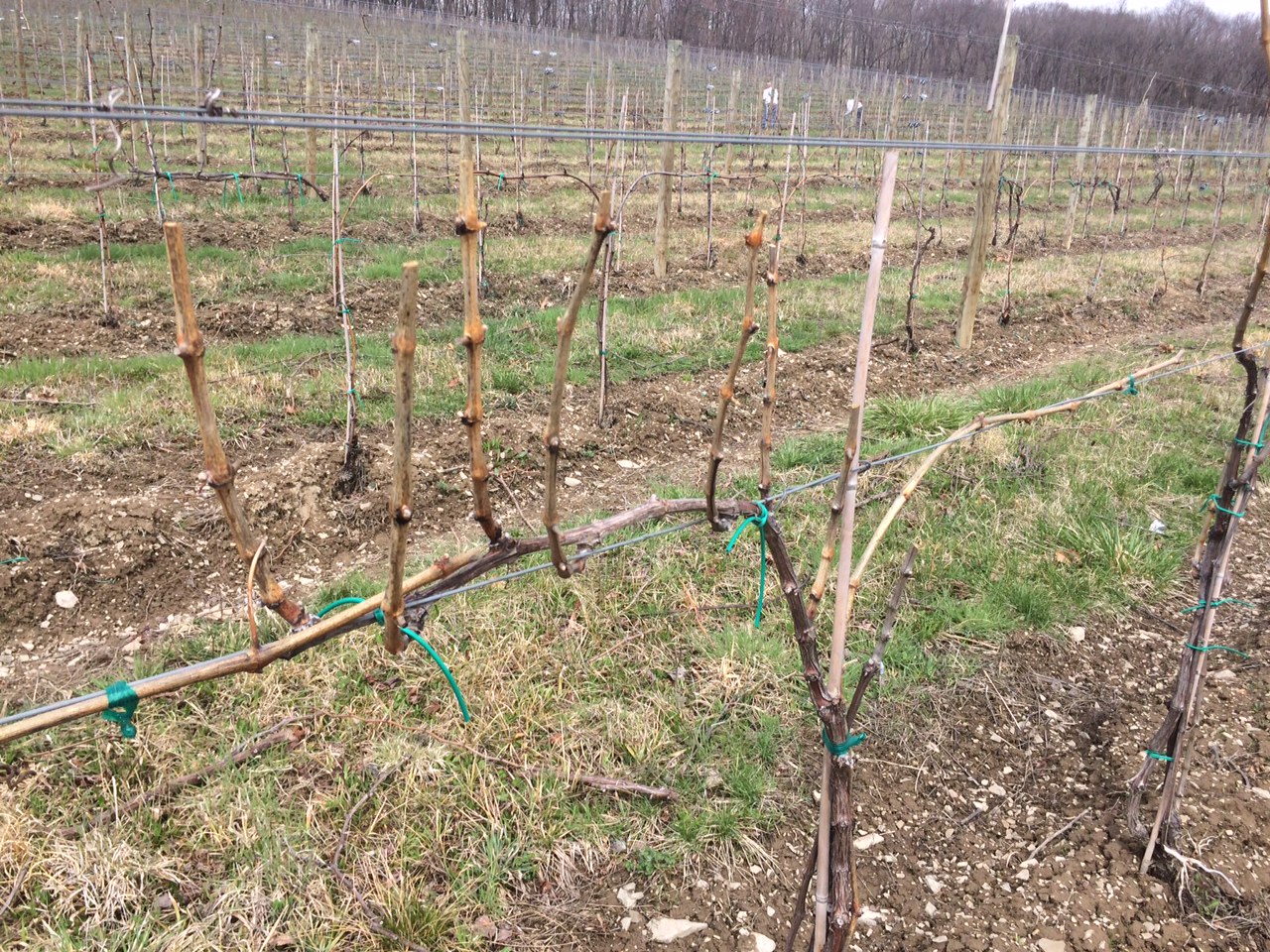
Spur and Kane pruning on same vine @ Briar Valley Vineyards

Spur and Kane pruning on same vine @ Briar Valley Vineyards

     Welcome to the 2nd Annual ” State of the Vineyard” address. the purpose of this post is to give everyone a first look at the 2015 growing season as seen through the eyes of the people who know it best, the growers and wine makers of Western and Central Pennsylvania. After a winter that broke records for cold and snow I found unexpected good news on all fronts. But don’t take it from me read what the experts had to say.

We will start in Central Pennsylvania with Paul Vezzetti winemaker at The Vineyard at Hershey. Paul tells me that their vineyards made it through the winter relatively unscathed by the sub-zero temperatures, even the normally cold sensitive Chardonnay and Riesling showed little damage and with pruning complete he is looking forward to a really big year. A year that will see a new block of vines added to the vineyard that will consist mostly of Muscat but also some Sauvignon Blanc.

      Staying in Central Pa. our next stop is Lewisburg and Chuck Zaleski’s Fero Vineyards & Winery. Chuck grows only vinifera vines and over the last two winters his vine injury has been limited to only a “couple percent”. He feels fortunate to have his vineyard in the Middle Susquehana Valley on a small hilltop in a wide river valley at 41ºN latitude and 600 feet above sea level. He attributes his site for his excellent survival rate that his vineyard has experienced over the years. I want to congratulate Chuck on winning a Double Gold medal at the Finger Lakes International Wine Competition (FLIWC) with his 2013 Estate Lemberger and a Gold with his 2013 Saperavi also at FLIWC.

We now move west into Washington County the home of Ripepi Vineyards & Winery. Rich Ripepi is pleased with how his vines came through this winter. He lost some of his Cabernet Sauvignon vines last winter but the ones that survived made it through this winter in fine shape. The bud count is very good and is a product of an extremely strong growing season in 2014. The only negative Rich could report was a little damage to his 28-year-old Chancellor vines but he couldn’t put his finger on the exact cause. With all the primary trimming complete and half of the secondary done Rich could only express the highest hopes for this coming growing season.

I can never go to Bedford County without stopping to see Tod & Jean Manspeaker at Briar Valley Vineyards & Winery. Tod tells me that this winter was better than the winter of 2014 for their vineyard. The 2014 winter had two freeze events with the second damaging some vines by splitting their trunks and causing “Crown Gall” which will eventually destroy a vine once it’s infected. But this year was different, most of Briar Valley’s vines came through in good shape with the only exception being their Merlot. They had thought they lost 100% of the Merlot vines and had order new vines only to discover that a third of the vines had survived. Tod commented on how differently each variety of his vinifera grapes vines adapted to the environmental factors even though they were all on the same site. The Manspeakers are very busy now with about 1 to 1 1/2 weeks more of pruning to do on their 10 acre vineyard. They do all the pruning themselves to insure that the fruit meets their very high standards. The job this year was made even more difficult by the fact that all the extra canes left on last year had to be removed to prepare the vines for this years growing season. I am happy to report that Briar Valley Vineyards & Winery won two Silver medals at the Finger Lakes International Wine competition (FLIWC) with their 2010 Proprietor’s Red and 2012 Lemberger. 

Our next stop is Greene County to visit Rick Thistlewaite at Thistlewaite Vineyards in Jefferson. Rick told me his vines had a “little more die back” this year but overall damage was minor with it limited to one or two vines per acre. The bud count at Thistlewaite is reported to be good. A two tier pruning protocol is employed where the first pruning leaves a long cane to develop buds that is then cut back with a second pruning after the first frost to give protection against late frost bud damage. When I asked Rick if he thought the site was a contributing factor in this year’s losses, he said that he didn’t think it was because his five acre vineyard is on a hilltop and is planted with all French hybrid vines. His opinion was that this past winter was wetter than last year and he had less snow cover to protect his vines. Thistlewaite Vineyards are planted with nine different varieties of wine grapes with the majority of the vineyard composed of Chambourcin and Traminette. Rick is anticipating another above average harvest this year.

For our last stop in Pennsylvania we will travel to the heart of the Laurel Highlands and make a visit to Christian W. Klay Winery in Chalk Hill. I had the pleasure of meeting Sharon Klay recently and had the opportunity to hear for myself how the winter effected her vineyard. Sharon said this winter wasn’t nearly as destructive to her vines as the last winter was. I could hear the lingering lament in her voice as she recalled losing two acres of her oldest Chardonnay last year but she quickly brightened when she reported the lack of damage this year and the promise of another banner year that lay ahead. I laughed as she told me the resident flock of wild turkeys at the vineyard had discriminating palates for which grapes they ate while leaving others varieties relatively untouched. On the day we talked her son, Christian had just received government approval for his distillery. After becoming fully operational it will offer a synergy with the winery by not only producing its own distilled spirits but using C.W.Klay wine to make grappa, brandy and other distilled products.

     No report would be complete without checking in with our friends in the Finger Lakes Wine Region. Martha “Marti” Macinski reports the vines at Standing Stone Vineyards & Winery Hector, NY do not seem to have suffered damage from this winter. She said the current bud count numbers are showing minimal damage, so minimal that “We did some samples twice”. Last year the samples also showed minimal damage and the crop was of normal quantity with overall quality outstanding. Riesling and Gewürztraminer continues to be strong varieties for Standing Stone with positive growth in the New York Metro area due to the efforts of distributor Fredrick Wildman. When visiting FLX a stop at Standing Stone Vineyards & Winery is a must for any wine lover.

Thank You to everyone that helped me with this post. I wish all the vineyards and wineries the best of luck in 2015 and I hope to see you soon.    Rich


Saperavi: The Next Big Thing?

Saperavi Grapes Photo Courtesy Wikipedia

Saperavi Grapes Photo Courtesy Wikipedia

     The Red Wines of the East Coast have never gotten the love that their White Wine counterparts have received over the years and in most cases for good reason.  But that may change if an old Eastern European grape can live up to its promise of becoming the foundation on which the future of eastern Red Wine is built.  The wine grape that I am talking about is Saperavi.  This grape variety originated in the Georgian Republic of Russia and features a dark skin with

Chuck & Daneen Zaleski Owners Fero Vineyards & Winery

Chuck & Daneen Zaleski Owners Fero Vineyards & Winery

pink flesh.  It is a teinturier variety of grape, meaning unlike most grapes that have uncolored flesh and produce clear juice a teinturier has red-tinted flesh that makes a vibrant richly colored wine. Saperavi vines are grown throughout the area connecting Asia and Europe know as the Caucasus and in various regions of the former Soviet Republic. Sapervai has long been viewed as an ideal ingredient for cheaper blended wines but in recent decades it has been proven to be capable of producing a varietal of high quality.  The best Georgian-produced Saperavi comes from the Kakheti Region that is near its eastern border with Azerbaijan.  These Georgian-made wines are available in the U.S. but you will have to do some searching to find them. The fact that this grape is late-ripening and thrives in a cooler climate while producing generous yields without sacrificing much in quality is the reason that vintners in the Finger Lakes and Central Pennsylvania are exploring its potential within their vineyards.  I have mentioned in earlier posts the pioneering work done by the Standing Stone Vineyards and Winery with Saperavi but I have recently learned of a producing vineyard in Lewisburg, Pa.  Chuck and Daneen Zaleski owners of Fero Vineyards and Winery have produced a varietal from Saperavi grapes grown in their Central Pennsylvania vineyard and made exclusively in their Lewisburg winery.  Chuck Zaleski at Fero and Marti Macinski at Standing Stone are on the cutting edge of this exciting reinvention of an Old World stalwart.  I am excited to have the chance to follow the evolution of the Saperavi wine grape in the Eastern United States from the persceptive of the wine makers themselves. For more information about these two fine wineries visit their websites at: www.standingstonewines.com  and  www.ferovineyards.com

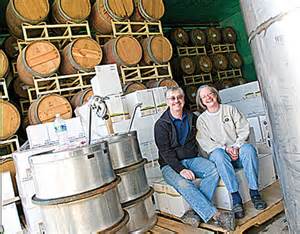
Tom & Marti Macinski  Owners Standing Stone Winery Photo Courtsey:Examiner.com

Tom & Marti Macinski Owners Standing Stone Winery Photo Courtsey:Examiner.com

Standing Stone Vineyards Go Vertical

Saperavi Grapes Photo Courtesy Wikipedia

Saperavi Grapes Photo Courtesy Wikipedia

     Standing Stone Vineyards to host a vertical tasting of their popular Saperavi on Sunday November 16, 2014.  Tom & Marti Macinski become the first vintners in the nation to bottle the Saperavi grape under its newly recognized and rightful name.  The N.Y. Wine & Food Classic double gold medal-winning 2012 vintage will be part of the November 16th tasting.  This vintage is featured in the November 30th issue of Wine Spectator Magazine where it was awarded a 88 point rating.  Owner and winemaker Marti Macinski will be leading the two Saperavi vertical tasting sessions Sunday afternoon at 1:00 and again at 3:00.  This is a great opportunity for guests to learn from the leading expert on this up and coming wine grape.  Tickets are $20 and include food pairings from Dano’s. Reservations can be made by calling 607-582-6051 or by e-mail at ssny@standingstonewines.com.

Standing Stone Vineyards Releases 2012 Saperavi


Photo Courtesy: Standing Stone Winery

Photo Courtesy: Standing Stone Winery

Standing Stone Vineyards “Officially” releases 2012 Saperavi.  Standing Stone becomes the first winery in the U.S. to bottle and release the newly classified Saperavi grape under its newly recognized and rightful name.  In conjunction with the iconic Dr. Konstantin Frank Cellars, Standing Stone Winery filed a petition with the Federal Alcohol and Tobacco Tax and Trade Bureau in late December 2013 to have the Saperavi grape recognized as an approved wine grape variety.  The Saperavi grape is a cold weather grape that originated in Georgia, Russia.  Owner and winemaker Marti Macinski has always had a fondness for this grape said “We’ve been growing Saperavi for 20 years and we’ve been using it in blends and bottling it under different names.  But now that Saperavi is again an officially recognized grape, we are thrilled to be able to put it on our label.  And I’ve got to tell you this 2012 vintage is unbelievable.  The vines have really grown to maturity and we have 20 years experience of working with the grape and understanding how to bring out its characteristic in the bottle”.  This grape has grown well in the Finger Lakes “Banana Belt” and is believed to be able to grow anywhere Riesling thrives.  Saperavi grapes produce a deep red wine with good structure and texture that is rich but not overly tannic.  This could be the grape that elevates the reds of the Finger Lakes to a level that would provide a nice complement to the world-class whites of this region.  

Standing Stone Vineyards Riesling Release

Ripe grapes of Riesling.

Ripe grapes of Riesling. (Photo credit: Wikipedia)

     I received a press release from the Standing Stone Winery that proudly announced the release of their Old West Block Riesling.  This is a single yeast Riesling named after the oldest vineyard on their property that was planted in 1972 by Gold Seal Vineyards.  Marti Macinski and her husband Tom take great pride in making the best Riesling and Gewürztraminer possible from the ground up in the Finger Lakes Region.  In 2012 due to the increased production from the Old West Block vineyard they were able to harvest enough grapes to produce a truly artisanal single vineyard bottling.  The grapes were picked at 22.5 Brix and the wine was bottled with a R.S. of 1.4%, 3.00pH and a total of 7.4 g/l.  After reading the tasting notes I was left the with the impression that this Riesling has aromas of apricots and pears with a flavor palate of ripe fruit complemented by a hint of white peach, smoked tea and white pepper in the background.  The finish is long and lingering but bright due to its lively acidity.  Standing Stone Winery made only 129 cases of Riesling  with the grapes harvested from the Old West Block and of the first 129 cases only 50 remain, that means it is in short supply and with single bottles priced at $18.99 it won’t last long. 

Winter at Standing Stone Winery

Wine Barrels  Photo Courtesy Standing Stone Winery

Wine Barrels  Photo Courtesy Standing Stone Winery

I have just heard from Martha Macinski or Marti as she is known to everyone in the Finger Lakes.  She updated me on the happenings around the Standing Stone Winery that she and her husband Tom have owned since 1991.  They have just finished pressing frozen grapes to make Riesling Ice and Vidal Ice.  The grapes are not picked frozen but are picked as late harvest and then frozen commercially so that they may be pressed to make Ice wine.  The Riesling Ice 2012, Vidal Ice 2011 and the Riesling 2012 are all ready and will be bottled in early March.  One of the nice things about stopping by the tasting room during the winter is that there are fewer people visiting so Marti and her staff will have more time to talk and share details about the wine.  The vineyard crew is busy fixing any trellis components that have broken over the previous growing season.  Pruning will start in February and after that task is completed the vines will be tied up before bud break in the spring.  There was some concern that the recent spike in temperatures would reduce the snow cover that protects the vineyard during the winter but the cold nights and the return of normal winter weather prevented any damage to the vines.  Marti made me laugh when she told me that ” You would be surprised how much work it is to taste 10 barrels of Standing Stone Saperavi.”  I know it is a tough job but I guess someone has to do it :-).  They will be bottling some 2010 and 2012 wines in April and May with the 2010 Cabernet Sauvignon and the Merlot being of reserve status and reportedly delicious!  Thanks to Marti for keeping me informed on the latest news from Standing Stone Winery which is on the eastern shore of Seneca Lake in Hector, NY.  If you want more info you can visit the website www.Standingstonewines.com or go to their Facebook page.