There is an old adage “What was old is new again”. This saying has never rung more true than it does today for the alcoholic beverage industry. As total wine sales revenue and volume continue to decline, producers are searching for trendy new taste profiles and production methods to entice new customers and lure back old ones. Co-fermenting grapes, grape skins, and wine with beer become a beverage the French call “Vière”. Vière is steadily gaining popularity in the Northeastern part of the United States and across the country. Our region has an abundance of high-quality fruit and talented beverage makers, making it an ideal environment for developing a thriving Co-fermenting community. An increase in demand for high-quality fruit enhances the opportunity for the expansion of vineyards, orchards, and fruit farms in our region. The economic implications of a sizable jump in agricultural production would provide more support for our local economies throughout the Northeast and beyond. An upsurge in vineyard acreage could lend itself to the planting of more Heritage grape varieties that are especially suitable to the production of Vière, such as Anne Noir, Bacchus, Delaware, Jefferson, Isabella, Marion, and others. These varieties have the added benefit of adapting to changing weather patterns and climatic conditions.
The process of Co-fermenting is when winemakers, brewers, or cider-makers merge and intermingle different production methods to make wine, beer, or cider that can display fun and unique flavor profiles. If you have tasted any of these beverages that have fruit added to them during their fermentation, you have experienced co-fermentation. The lines that define what constitutes wine, beer, and/or cider have become increasingly blurred. Those lines do not get any clearer when you factor in a producer’s willingness to readily accept the effects of wild yeasts, Brettanomyces, volatile acids, and certain bacteria that until recently would have been viewed as an imperfection.
The question I kept asking myself was “Who is embracing this movement toward Co-fermented beverages with unusual tastes that also includes Pet-Nat, organic, low intervention, and Piquette wines?” Is it a younger consumer demographic searching for its identity to experience something different?
For some insight into this new trend, I went to a trusted and knowledgeable source, who also happens to be a friend of mine, J. Stephen Casscles, Esq. Steve is a well-known authority on Heritage Grapes, and author of the new 2nd edition of “Grapes of the Hudson Valley and Other Cool Climate Regions of the U.S. and Canada”, which includes two new chapters on Heritage grape varieties bred in New England ( https://www.flintminepress.com/product/grapes-of-the-hudson-valley/ ) and, who has received the 2023 Atlantic Seaboard Wine Association’s prestigious Birchenall Award.
I asked Steve — “As consumers, what should we know about and expect from the growing Co-ferment movement?” Steve’s comments were as follows:
First, this new trend in Co-fermented beverages will be very helpful to our fruit growers, as it is a new revenue source for our struggling growers who are looking for new markets to sell their grapes, stone & pome fruits, and berries. In addition, it helps a grower’s cash flow, as Co-ferments can be made and sold within 8 weeks of harvest, which coincidentally is just before the busy Holiday Season. This is especially true since, more and more, growers are also operating their own wineries, breweries, and cideries to process and sell their own fruit.
What many of our colleagues in the Northeast and I find fascinating about Vière and other Co-ferments is that the sum of the parts is often greater than the separate parts of a beverage that has been made separately as a wine, beer, or cider. I have had the pleasure of working with many talented brew masters of beer and cider who make these Co-ferments. These people all live near me in the Mid-Hudson Valley, New York and include Zane Coffey and Max Ocean of Subversive Brewery (drinksubversive.com); Andre Latour of Brewery LaHoff (brewerylahoff.com); J.D. Linderman, Mikey Lenane, and Bob Wise of Return Brewing (returnbrewing.com), and Denny Brownell of Heartsby True Cidery (heartsbytrue.com).
These Vières can have exciting colors of bright purple, hot pink, or electric blue, that are appealing to our younger consumers; and possess the presence and body of a wine spritzer, with half of the alcohol and calories of a standard table wine. The beverage’s carbonation can be similar to a beer, but the bubbles make the grape or other fruit flavors jump out of the glass to make a unique beverage that is not a wine, beer, or cider. The body can be as light and refreshing as a beer, but with the added complexity that grapes or other fruits can bring to it. Andre Latour of Brewery LaHoff states that “ it appeals to beer enthusiasts and wine drinkers alike. It’s a beer that almost drinks like wine. As you imbibe, you can explore the unique characteristics of both wine and beer simultaneously.” Co-ferments have the potential to exhibit many different flavor profiles, so the flavors and texture of these beverages are very broad, which is appealing to our newer and younger customers.
As an observation, I find that in making wine, the winemaker is limited to the flavor profile of the grapes that they have and that this fruit must be processed as soon as it has been harvested. With Co-ferments, the wine/beer/cider maker has much more freedom to craft the kinds of beverage colors, body, nose, taste, carbonation level, and alcohol content that the producer and customer may want. In addition, unlike in making grape wine, these fruits can be frozen and stored so that the craft brewer can make these beverages not only how they want, but when they want. This gives far more control to the craft brewer than is possessed by a winemaker.
At Dear Native Grapes Winery in Walton, NY, (http://dearnativegrapes.com) where I work to help make some wine, the owners Alfie Alcantara and Deanna Urciuoli, have been concentrating on making standard table wines, Pet Natsand Natural Wines; and are considering making wines that contain fruits other than grapes. What we are seeing is that there is a merging of how craft wines, beers, and ciders are being produced, with experimentation in the kinds of yeasts used, fruits added, and carbonation levels that are being achieved. The addition of Co-ferments to the product line-up increases the interest and draw that customers have for their winery, brewery, or cidery.
Vière and other Co-ferments are becoming more popular all along the East Coast and for beverage producers east of the Mississippi River. I welcome you to seek out your local brewery, winery, or cidery and see if they are producing these exciting beverages. For more articles on Co-ferments, see these articles that I have written, “Co-Ferments Come of Age in the Northeast”, Wine Journal (The Official Journal of the American Wine Society), Scranton, PA. vol. 56, no. 2 (2024): 16-18 and“Co-Ferments Come of Age in the Northeast: Increasing the Demand for Local Fruit”, Horticultural News vol. 104, no. 1, Winter (2024): 17-20 and Fruit Notes vol. 89, no. 1, Winter (2024): 22-25.
Either way, I recommend that you get out and try these fun and new beverages.
The North American co-fermentation movement has gained a loyal following that continues to grow and broaden in its appeal to a diverse segment of the adult beverage market. Co-fermented products provide growers and producers a shorter turnaround on their investment because these offerings can be made and sold quickly. The makers of these various co-ferments will continue to evolve their skills and techniques. They will have their successes and even more failures but the reality is that they are business people and they must be profitable to keep their operations viable in the long run. It will be not only interesting but educational to watch as this sector of the industry matures.
Thank you Steve Casscles for your invaluable contribution to this article, without it this story would not have been possible.

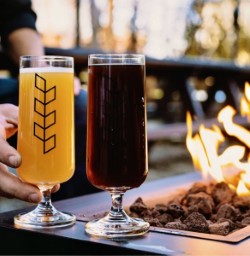

Photo Courtesy: Return Brewing and Subversive Brewing


Great to read all the interesting initiatives around co ferments . However as you say – what is old is new again – It seems this was a common practice in pre BC mediterranean culture as discovered in ancient Roman and Etruscan amphora
LikeLiked by 1 person
Thanks for subscribing When something like co-fermenting works why try to reinvent the wheel all you have to do is modernize it a little.
LikeLike